Academic Film: Admission

Tina Fey, Wallace Shawn and Gloria Reuben in Admission (2013)

Tina Fey, Wallace Shawn and Gloria Reuben in Admission (2013)

By now you’ve probably seen that New Republic article “Don’t Send Your Kid to the Ivy League”, and all the rebuttals, and all the rebuttals to the rebuttals. In the article William Deresiewicz provides a rather thorough and convincing (if unoriginal) critique of elite college preparation. It’s a hyper-competitive process that begins at infancy (for kids from elite families), encourages the most cynical and cutthroat behavior from students, and, as Deresiewicz and others have argued, undermines the very purposes of college. (Personally, I liked the way the film The History Boys dealt with all this in a British context.) My biggest problem with the article (besides his swipe at race-based affirmative action) is that he had very little to say about public universities, community colleges and for-profit colleges where the students aren’t all college-prep-programmed youngsters, and where “admissions” operates under a whole different paradigm. This is by far the largest and fastest growing segment of higher education, and the one that most of us will encounter. He can critique the Ivy League all he wants, but the kind of prestige signified by an Ivy League education is one that is remarkably resilient, even among those of us who are happy with our non-Ivy League educations, or who never attended college at all. To some degree I think we all buy into and attach value to the prestige of being affiliated with an Ivy League institution, even when we should know better.

In my “Storifying the Academy” article that I posted a few months ago I made a backhanded comment about the recent academic film Admission. After viewing it again, I stand corrected. There’s more to this film than Lily Tomlin’s performance (though she does have some great lines). Admission is actually an interesting examination of the admissions process, this ritual of rejection and acceptance that millions of students put themselves through each year. The film dramatizes what this process means for the administrators and students involved, and what this process says about the way higher education functions, particularly at its most elite levels.

Like most academic films and novels, this one has been judged according to how well it represents the real-life academy. Suffice to say there are exaggerations and embellishments, but not all of them are bad. When the film was released in theaters in 2013, Inside Higher Ed hosted a discussion with some actual admissions officers about the veracity of the film. Vulture published an interview with Jean Hanff Korelitz, author of the novel upon which the screenplay is based, and screenwriter Karen Croner.  Korelitz and Croner provide an interesting discussion about the process of bringing this particular novel to the big screen, and also about how film adaptations often differ from their novels.   (And since I began with the New Republic article it is also worth noting here that William Deresiewicz himself has written about academic fiction before: see “Love on Campus”)

In her study of academic fiction The University in Modern Fiction: When Power is Academic, Janice Rossen writes about the ways that power, inclusion and exclusion define university life. For Rossen, Thomas Hardy’s Jude the Obscure is the exemplary academic novel because its main character yearns to be a part of Christ Church, Oxford, but as a working-class stone mason and an autodidact he really stood no chance to enter the hallowed walls of the university. He didn’t have the proper training and pedigree, and there was no way for him to work his way into that kind of prestige.

Admission follows the story of Portia Nathan (Tina Fey), an admissions officer at Princeton. The Director of Admissions (Wallace Shawn) is distressed over the fact that Princeton has fallen to number 2 in the U.S. News & World Report rankings. (Of course, we don’t really put any stock in those rankings, do we? They’re just fun to look at, right?) And so he sends his admission team out to find the freshman class that will put them back on top.

Portia accepts an invitation from John Pressman (Paul Rudd), the principal of The Quest School, an alternative high school with an eccentric curriculum, to come speak to his students about admission to Princeton. It is there that Portia meets a modern-day “Jude the Obscure” in the form of Jeremiah, a student with a terrible academic record, who also happens to be a brilliant autodidact who has aced every AP test that he took (without taking any AP classes) and has a near perfect score on his SATs.

In one sequence Portia gives her admissions spiel to students at an elite prep school, where, decked out in uniforms, they listen to her with respect and obedience. Cut to her scene at Quest, however, and Portia finds herself giving the same talk in a barn (part of the school’s hands-on learning environment) and facing a barrage of snarky questions and comments from a bunch of smart-aleck students such as: “Why should I apply to an elitist institution with a history of anti-black, anti-gay and anti-female oppression?” and “Wouldn’t you be better off sitting in your room reading books?” and “Don’t people just need a college degree if you want to pursue the societally approved definition of success?” As one student puts it, “what we want is to leave the planet better than we found it.” The questions and comments are certainly valid and refreshing to hear, but they also represent a certain sarcastic and cynical attitude toward formal education that has become all too cheap and easy. Portia finally fires back at them with a spirited defense of her profession. “I have a question for all of you. Just how will you leave the planet better? Do you want to eradicate disease? Well, you’re going to need a medical degree. If you want to create new drug therapies, that’s a Ph.D. If you want to defend the innocent and secure justice for all, I regret to inform you that you will have to go to law school!” And I think she was right to push back against their knee-jerk sarcasm. It’s easy to lapse into this snarky attitude about higher education. Yes, higher ed has certainly earned those doubts with its constant tuition increases, expensive textbook extortion schemes, and its massive student loan debt system. But I doubt any of us really wants to have surgery performed by a self-taught doctor whose only training came from reading Gray’s Anatomy and studying biology and chemistry MOOCs on Academic Earth.

Portia soon finds out (MAJOR SPOILER) that Jeremiah may be the son that she gave up for adoption years ago when she carried out an unexpected pregnancy while a student at Dartmouth. And then on top of that emotional bombshell, she experiences an embarrassing and humiliating breakup in a hilarious bit where her nebbish English professor boyfriend (Michael Sheen) leaves her in the middle of a dinner party by confessing that he’s impregnated a colleague who Portia describes as “that vile Virginia Woolf scholar.”

It’s obvious why Portia’s judgment about Jeremiah is skewed when it comes to his chances for admission. The breakup has left her emotionally out of sorts, and learning about Jeremiah brought back so many difficult questions about her life choices. Portia is so intent on him getting into Princeton because she feels he deserves it, because she wants him close to her, and because in her worldview, this is the best thing that she can do for him. In the process she fails to consider one simple idea: Maybe it is Princeton that doesn’t deserve to have Jeremiah. Maybe he would be better off somewhere else – say a liberal arts college like Reed College – where his eccentricity would be seen as an asset rather than a liability.

The film deserves credit for its portrayal of women in positions of authority in the academy. There’s an interesting give and take between Portia and her colleague Corinne (Gloria Reuben) who are both vying to be the new Director of Admissions. Throughout the film we see women having to negotiate child-rearing and babysitting, the difficulty of getting “emotional” as a woman in a professional setting, and jokes about the need for “sisterhood” even as they are in fierce competition for the same positions.

Mostly the film worked for me because it shows the irresistibility of these hierarchies of prestige. Getting into Princeton means something. Winning an appointment as an Ivy League professor means something. Even for those of us who claim we don’t believe in such hierarchies, we still lapse into celebrating that prestige, when say, an Ivy League school happens to hire a scholar whose work that we really like, or when one of our own children or family members or friends gets accepted or hired by one of these schools. Being admitted into those halls is incredibly validating, a powerful signifier of status and success, and that kind of prestige has been centuries in the making.  Admission makes the case that even when we’re at our most critical of Ivy League prestige, it can’t easily be shaken, least of all by those who are deeply embedded within it.
Academic Novel: Japanese by Spring (Draft)

japanese by spring - Cover 3_0

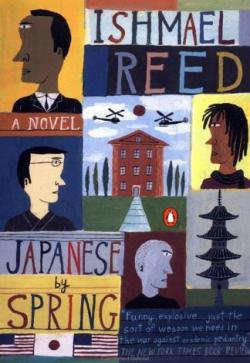
Here’s something that I’ve been meaning to do for a while. At the bottom of this post is an earlier and much shorter draft of my chapter on Ishmael Reed’s Japanese by Spring.  I presented this version back in November 2011 as part of the University of Pennsylvania’s conference Intersections: A Conversation Between African American and Asian American Studies.  It was posted on the conference website along with the other papers, all of which can still be accessed here.  Since it has been floating around on the web for a while (and shows up pretty high in the Google searches on Japanese by Spring) I wanted to go ahead and put it directly on this blog. Stupidly, I didn’t put my name on the original .pdf, not realizing it would be uploaded to a public conference site.  (A lesson to all the kids out there.)

Again, this was just a draft, and a shortened draft for the conference.  The final chapter version is about 40 pages with a more substantive discussion of The Culture Wars. I also added some commentary from Michele Wallace’s excellent essay “Ishmael Reed’s Female Troubles” from her book Invisibility Blues: From Pop to Theory. (The essay originally appeared in the Village Voice in 1986). And thanks to the UPenn conference I also got keyed into some more scholarship on Afro-Asian studies, so there’s more about that in the final chapter as well.

The chapter title is now: “Culture Warriors: Multiculturalism and the Black Professor in Ishmael Reed’s Japanese by Spring.”

So here’s the shorter draft version from 2011:

Black(ness) No More: Academia and the Culture Wars in Ishmael Reed’s Japanese by Spring

Black Academic Fiction: A Working Bibliography

Cherise Boothe, seated, and LisaGay Hamilton in Adrienne Kennedy's

Cherise Boothe, seated, and LisaGay Hamilton in Adrienne Kennedy’s “The Ohio State Murders” staged by the Theater for a New Audience at the Duke on 42nd Street, in November 2007.

Below is a bibliography of black academic fiction works that I have been able to identify so far.  Once again,  the annotated bibliographies The American College Novel (2004) and Academe in Mystery and Detective Fiction (2000) were rather helpful in locating several of the novels that I list here.

This bibliography is organized under the broad rubric of “academic fiction” to include different creative forms. I think this list shows the impressive range and diversity of academic fiction produced by black artists exploring many different aspects of higher education. However, once I got into the research process I decided that focusing on the genre of the novel gave me better critical possibilities.  (More about that later)

Essentially, I am focusing on works that have some significant content about  higher education or intellectualism as a major part of the plot.  I have excluded those works which might have an academic character or two but which don’t really deal with academic/intellectual life.  When I began this project, I intended to focus on black writers who have written academic fiction, and mostly that focus remains the same.  However, I do include some non-black authors whose books explore black higher education  (Philip Roth’s The Human Stain is one of the most prominent examples).  Though I have done my fair share of reading, I will admit I haven’t vetted every single book on the list yet, so some cuts and additions are likely to happen.  The list is an ongoing project and suggestions are welcome.

BLACK ACADEMIC FICTION: A WORKING BIBLIOGRAPHY

NOVELS

Anderson, Walter. Pledge Brothers. Arlington: Milk and Honey, 2001.

Appiah, Kwame Anthony. Avenging Angel. New York: St. Martin’s Press, 1991.

Beatty, Paul. The White Boy Shuffle. New York: Picador, 1996.

Bradley, David. The Chaneysville Incident. New York: Harper & Row, 1981.

Briscoe, Connie.  Big Girls Don’t Cry.  New York: HarperCollins, 1996.

Butler, Tajuana. Sorority Sisters. New York: Villard, 2001.

Carter, Stephen.  The Emperor of Ocean Park. New York: Vintage Books, 2002.
—-. New England White: A Novel. New York: Vintage, 2007.

Colter, Cyrus.  A Chocolate Soldier. New York: Thunder’s Mouth Press, 1988.

Delany, Samuel R. The Mad Man. Rutherford: Voyant Publishing, 2002.
—-. Dark Reflections.  New York: Carroll & Graff, 2007.

Du Bois, W.E.B. The Quest of the Silver Fleece: A Novel. 1911. New York: Random House, 2004.
—-. The Ordeal of Mansart, Vol. 1 of The Black Flame Trilogy. 1957. New York: Oxford University Press, 2007.
—-. Mansart Builds a School, Vol .2 of The Black Flame Trilogy. 1959. New York: Oxford University Press, 2007.
—-. Worlds of Color, Vol 3. of The Black Flame Trilogy. 1961. New York: Oxford University Press, 2007.

Ellison, Ralph.  Invisible Man.  New York: Random House, 1952.

Everett, Percival.  American Desert. London: Faber and Faber, 2004.
—-. Erasure.  New York: Hyperion, 2001.
—-. Glyph. Graywolf Press, 1999.
—-. I Am Not Sidney Poitier. St. Paul: Graywolf Press, 2009.

Gay, Phillip. Academic Affairs.  1st Books, 2003.

Grant, Tracy. Hellified.  New York: Visao, 1993.

Griggs, Sutton. Imperium in Imperio: A Study of the Negro Race Problem.1899. New York: Modern Library, 2003.

Heron, Gil-Scott.  The Nigger Factory. 1972.  Edinburgh: Cannongate Press, 2001.

Himes, Chester.  The Third Generation. 1954. New York: Thunder’s Mouth Press, 1989.

Hughes, Althea. Walking the Line. Arlington: E.R.L., 2000.

Jackson, C. R. Mistrustful. College Park: Media Management International, 2000.

Johnson, Mat.  Pym: A Novel.  New York: Spiegel and Grau, 2011.

Johnson, T. Geronimo. Welcome to Braggsville. New York: HarperCollins, 2016.

Larsen, Nella. Quicksand. 1928. New Brunswick: Rutgers University Press, 1986.

Marshall, Paule.  The Chosen Place, The Timeless People.  New York: Random House, 1969.

McKnight, Reginald. He Sleeps: A Novel.  New York: Macmillan, 2002.

Moon, Bucklin. Without Magnolias. New York: Doubleday, 1949.

Morse, L.C. Sundial. 1986. Bloomington: iUniverse, 2010.

Murray, Albert. The Spyglass Tree.  New York: Pantheon, 1991.

Peterson, Brian. Move Over, Girl. New York: Villard, 1998.

Raboteau, Emily.  The Professor’s Daughter. New York: Henry Holt and Co., 2005.

Redding, J. Saunders.  Stranger and Alone. New York: Harcourt, Brace, 1950.

Reed, Ishmael. Japanese by Spring.  New York: Atheneum, 1993.

Robinson, C. Kelly. Between Brothers.  New York: Villard, 1999.

Rosenman, John B. The Best Laugh Last. New Paltz: Treacle, 1981.

Roth, Philip. The Human Stain. New York: Vintage, 2000.

Smith, Zadie. On Beauty: A Novel.  New York:  Penguin, 2005.

Stribling, T. S. Birthright. 1922. Delmar, N.Y. : Scholars’ Facsimiles & Reprints, 1987.

Thomas-Graham, Pamela. A Darker Shade of Crimson. New York: Simon and Schuster, 1999.
—- . Blue Blood. New York: Simon and Schuster, 1999.
—-. Orange Crushed. New York: Simon and Schuster, 2004.

Tyree, Omar.  Colored, on White Campus: The Education of a Racial World. Washington, D.C.: Mars Productions, 1992.  Re-issued and re-titled as Battlezone.  Wilmington: Mars Productions, 1994.

Walker, Alice. Meridian. New York: Simon and Schuster, 1976.

Whitehead, Colson. The Intuitionist. New York: Random House, 1999.

Williams, Dennis A. Crossover. New York: Summit Books, 1992.

Williams, Robyn. Preconceived Notions.  Chicago: Lushena Books, 1991.

Woodson, Jon. Endowed, a Comic Novel.  CreateSpace, 2012.

PLAYS

Jones, Leroi (Amiri Baraka).  The Slave (1964).  In Dutchman and The Slave: Two Plays. New York: Morrow, 1967.

Kennedy, Adrienne. The Ohio State Murders.  New York: Samuel French, 2009.

Rux, Carl Hancock. Talk. New York: Theater Communications Group, 2004.

FILMS

Birthright. Dir. Oscar Micheaux. 1939. Kino Lorber, 2016.

Brother to Brother. Dir. Rodney Evans. DVD. Wolfe Releasing, 2004.

Dear White People. Dir. Justin Simien. Code Red, 2014.

Drumline
. Dir. Charles Stone, III. 2002.  DVD. 20th  Century Fox, 2003.

The Great Debaters. Dir. Dentzel Washington. 2007. DVD. Harpo Films, 2008.

Higher Learning
. Dir. John Singleton. 1995. DVD. Sony Pictures, 2001.

Mooz-lum.  Dir. Qasim Basir.  2010. DVD. Rising Pictures, 2011.

The Nutty Professor.  Dir. Tom Shadyac. 1996. DVD. Universal Studies, 2007.

School Daze. Dir. Spike Lee. 1988. DVD.  Sony Pictures, 2001.

Train Ride. Dir. Rel Dowdell. Ruff Nation Films. 2000. DVD.

Something the Lord Made. Dir. Joseph Sargent. 2004. DVD. HBO Films, 2004.

TELEVISON

A Different World. (1987-1993). Executive Producer, Bill Cosby.  Carsey-Werner Productions. DVD. 2005.

Dear White People. Netflix, 2017 – .

The Quad. Black Entertainment Television (BET). 2016.

STORIES

Du Bois, W. E. B. “Of the Coming of John.”  The Souls of Black Folk.  (1903). Boulder: Paradigm Publishers, 2004.

—-. “Tom Brown at Fisk in Three Chapters.” 1888.  Creative Writings by W. E. B. Du Bois: A Pageant, Poems, Short Stories, and Playlets. Ed. Herbert Aptheker. New York: Kraus-Thomson Organization, 1985.

Dumas, Henry. “The University of Man.” Echo Tree:  The Collected Short Fiction of Henry Dumas. Minneapolis: Coffee House Press, 2003. 176-188.

Hughes, Langston. “Professor.” 1935. Short Stories: Langston Hughes. New York: Farrar, Straus and Giroux, 1996.

Marshall, Paule.  “Brooklyn.” Soul Clap Hands and Sing. 1961. Washington, DC: Howard University Press, 1988.

McPherson, James. Hue and Cry. New York: Little Brown & Co., 1968.

OTHER

Bell, Derrick.  Faces at the Bottom of the Well: The Permanence of Racism.  New York: Basic Books, 1992.

—- And We Are Not Saved: The Elusive Quest for Racial Justice. New York: Basic Books, 1987.


UPDATED: 14 March 2017