Choir Boy

On Tuesday night I went to see Choir Boy written by Tarell Alvin McCraney and directed by Trip Cullam, now playing at the Manhattan Theater Club through August 4th.

The play certainly resonated with my interests in the history of black education, and I found it to be a lively and intelligent exploration of complex issues related to blackness, sexuality, music and culture.  Being a graduate of an all-male historically black college (and one with a world-renowned glee club at that), I experienced many feelings of familiarity throughout the hour and half that we were there, feelings that resonated through the night and into the following days.  I am deeply grateful to my friend Jordan for telling me about the play and inviting me to go see it.

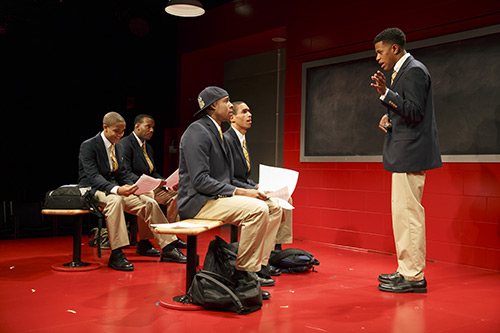
Choir Boy is set in the Charles R. Drew Prep School for Boys, an all-male black boarding school in the South.  The school is about to celebrate its 50th anniversary.  The choir is an important part of the school’s project of racial uplift, and the play gestures to the historical significance of choirs in the history of black education.  The Fisk Jubilee Singers is perhaps the most iconic of these black college choruses which were used to demonstrate the talent and discipline of black students, express the genius of black music, and to appeal to wealthy white philanthropists for support of these institutions.

The play features an openly gay lead character named Pharus Young (played by the wonderfully talented Jeremy Pope), who is the student director of the school’s acclaimed choir. “Flamboyant” might be a lazy and stereotypical term to describe him, but in this case it is precisely Pharus’s outgoing and energetic personality that animates the play and antagonizes other characters in the production. The playwright deftly uses this characterization to explore so many critical questions about black masculinity.
choirboy-photo-5

Pharus is among four other characters in the play who are in the school’s choir.  The show begins with him singing the school’s alma mater when he is interrupted by an off-stage voice who calls him a “sissy” and a “faggot ass nigga.” This causes Pharus to stumble in the middle of the song.  The school’s headmaster Dr. Morrow (played with booming gravitas by Chuck Cooper), did not hear the slur, and reprimands Pharus for flubbing the song at a critical moment in the commencement ceremony for that year’s graduating class. (The students in the play are ending their junior year and heading into their senior year). We find out that the verbal assault came from Dr. Morrow’s nephew Bobby Morrow, a fellow student who is Pharus’s macho adversary.  The slur lends an air of tension from the outset, and it gets repeated a few more times throughout the play.

The production overflows with the sounds of black music, and particularly focuses on the history and meaning of the “Negro spiritual.”  In one classroom scene Pharus delivers a stirring monologue about the meaning of spirituals and makes an argument that challenges idea that spirituals were always embedded with codes that helped slaves escape to freedom.  I’m still not sure how well that point works in the play.  Having studied black religion and history I was aware of this particular discussion, but I wondered how well that argument translated to audience members who may know less about the history of Negro spirituals.  At the time I also felt that the whole argument was forcefully wedged into the play in an unnatural way.  However, the discussion does help to escalate the conflict between Bobby and Pharus, because Bobby is so invested in the truth of spirituals as a practical tool of resistance, a side effect of his macho ideals of black manhood.  The argument between the two is an example of complicated critical discussions about black aesthetics among scholars in African-American Studies (and Africana Studies), and about the “functional” nature of black art.  Again, the gender representation is also important here, as Pharus makes an argument about black art that some might call “decadent” because he sees value in black creative expression as an end in itself, rather than seeing the need to justify art as a practical and functional tool of some larger political agenda. It is an argument a little more complex than a 100 minute play can handle, but I appreciated the attempt to bring it in.  As I have thought about it afterwards I now have a better appreciation of how this scene relates to the rest of the play.

My criticism of the way this argument works in the play speaks to a larger problem of cohesion.  The narrative at times felt fractured.  Storylines that I hoped would get a more satisfying resolution never do. Songs sometimes erupt without much narrative framing. And yet, it is the music that is the thread which holds it all together.  I loved the way that black music, not just gospel, but also hip-hop and R&B, is used as part of the play’s textual background.  Clips of contemporary music by Frank Ocean and others boom throughout the theater as the characters change the set between scenes.  And in a couple of scenes toward the end of the play, R&B song lyrics play a vital role in helping the characters to express troublesome feelings that they are otherwise reluctant to vocalize.   Though music did not always flow as seamlessly through the storyline as I wanted it to, there were definitely some potent ideas evoked and explored here, and the singing was always powerful and arresting.

After absorbing the play, and having a couple of drinks with my friend at the Ninth Avenue Saloon, I walked out into the hot, humid Manhattan evening bumping my way through the aggravatingly slow crowds of tourists in Times Square.  As I stood on the crowded Q train back to Brooklyn, my mind turned to a recent article written by Jafari Sinclaire Allen, a professor at Yale who taught the first LGBT studies course at Morehouse College last semester.  Allen wrote a Huffington Post article “On a Black Queer Morehouse Commencement” in response to President Obama’s graduation address at the school this spring.  As Allen points out in the beginning of the piece, both Michelle and Barack Obama have been criticized for comments made at their commencement speeches this spring, comments which some critics have interpreted as condescending in that they included a chastising tone that was not part of the Obamas’ usual commencement speeches at predominantly white schools.  Ta-Nehisi Coates wrote a provocative piece in The Atlantic which explored the class politics at work in the Obamas’ HBCU speeches.  But Jafari Allen goes on to praise President Obama for his daring acknowledgement of the presence of gay men in the Morehouse community, a particularly important act at a school which is seen as a bastion of black manhood, and at a school which has struggled to deal with issues of homosexuality and gender expression. (Vibe magazine’s sensational 2010 article “The Mean Girls of Morehouse” ruffled more than a few feathers.)  Jafari Allen’s article goes into detail about how the politics of respectability plays such an important role in all of this.  Many black folks are fearful that black gay men reflect badly on the image of the black community, and black LGBT people are often the targets of certain black nationalist ideas about the strong black family, reproduction, and appropriate manhood and womanhood.

Choir Boy addresses these ideas of gender and respectability at several points throughout the play.  Dr. Morrow and the other boys criticize Pharus for the way that he talks and acts.  In one stunning line, Dr. Morrow looks at Pharus with a look of disgust and says “your wrist”, a reminder of his embarrassing effeminacy.  Pharus responds to him: “so is this all about my wrist?!”  In a way, yes, it is!  His “limp wrist” is a great symbol for certain expectations of black manhood and illustrates how any outward expression of homosexuality is seen by some as a threat to those expectations.  Men who do not conform to norms of masculinity are often ostracized from the black community.  And yet the black church and the gospel music industry has at times provided a small space for alternative forms of gender expression.  Anyone who grew up in the black church is familiar with the “church sissy” whose sexuality may be an open secret, but who is given a “pass” because of his musical talents…just as long as he never explicitly says “I am gay and I love men.”  And I wish I could say this is just an issue among straight homophobes, but even within the black gay community effeminate men are often devalued, and gay men who are “straight acting” are assigned a higher social and sexual value.

But I hope I am not giving the impression that these characters in the play are simply “types.”  What was exciting about the play is that all of the characters are presented with intelligence and complexity.  While Dr. Morrow is critical of Pharus, he is not a mean-spirited villain and we see his compassion for all the boys in the school.  Like many black folks of the older generation, he is confused as to how to deal with the changes in the culture, including the acceptance of homosexuality, or their enthusiastic use of “The N Word.”  Likewise, some of the most touching moments come in the friendship between Pharus and his straight roommate Anthony, a strapping straight baseball player who befriends and accepts Pharus and is one of the few people who does not expect him to change who he is.  And Pharus himself is not a one-dimensional victim either.  We get to see him being nasty and vindictive and condescending to the other boys, even though the play ultimately comes down on his “side.”

Most of all, the play works because it is a relatable coming of age story about the confusion of adolescence, a story that transcends race and culture.  The dialogue is sharp and lyrical and often hilarious, and is delivered by the actors with skill and impressive timing.  And these choir boys can “sang” ya’ll!  The musical talent on stage is formidable and shines throughout the whole story.

Black Academic Fiction: A Working Bibliography

Cherise Boothe, seated, and LisaGay Hamilton in Adrienne Kennedy's

Cherise Boothe, seated, and LisaGay Hamilton in Adrienne Kennedy’s “The Ohio State Murders” staged by the Theater for a New Audience at the Duke on 42nd Street, in November 2007.

Below is a bibliography of black academic fiction works that I have been able to identify so far.  Once again,  the annotated bibliographies The American College Novel (2004) and Academe in Mystery and Detective Fiction (2000) were rather helpful in locating several of the novels that I list here.

This bibliography is organized under the broad rubric of “academic fiction” to include different creative forms. I think this list shows the impressive range and diversity of academic fiction produced by black artists exploring many different aspects of higher education. However, once I got into the research process I decided that focusing on the genre of the novel gave me better critical possibilities.  (More about that later)

Essentially, I am focusing on works that have some significant content about  higher education or intellectualism as a major part of the plot.  I have excluded those works which might have an academic character or two but which don’t really deal with academic/intellectual life.  When I began this project, I intended to focus on black writers who have written academic fiction, and mostly that focus remains the same.  However, I do include some non-black authors whose books explore black higher education  (Philip Roth’s The Human Stain is one of the most prominent examples).  Though I have done my fair share of reading, I will admit I haven’t vetted every single book on the list yet, so some cuts and additions are likely to happen.  The list is an ongoing project and suggestions are welcome.

BLACK ACADEMIC FICTION: A WORKING BIBLIOGRAPHY

NOVELS

Anderson, Walter. Pledge Brothers. Arlington: Milk and Honey, 2001.

Appiah, Kwame Anthony. Avenging Angel. New York: St. Martin’s Press, 1991.

Beatty, Paul. The White Boy Shuffle. New York: Picador, 1996.

Bradley, David. The Chaneysville Incident. New York: Harper & Row, 1981.

Briscoe, Connie.  Big Girls Don’t Cry.  New York: HarperCollins, 1996.

Butler, Tajuana. Sorority Sisters. New York: Villard, 2001.

Carter, Stephen.  The Emperor of Ocean Park. New York: Vintage Books, 2002.
—-. New England White: A Novel. New York: Vintage, 2007.

Colter, Cyrus.  A Chocolate Soldier. New York: Thunder’s Mouth Press, 1988.

Delany, Samuel R. The Mad Man. Rutherford: Voyant Publishing, 2002.
—-. Dark Reflections.  New York: Carroll & Graff, 2007.

Du Bois, W.E.B. The Quest of the Silver Fleece: A Novel. 1911. New York: Random House, 2004.
—-. The Ordeal of Mansart, Vol. 1 of The Black Flame Trilogy. 1957. New York: Oxford University Press, 2007.
—-. Mansart Builds a School, Vol .2 of The Black Flame Trilogy. 1959. New York: Oxford University Press, 2007.
—-. Worlds of Color, Vol 3. of The Black Flame Trilogy. 1961. New York: Oxford University Press, 2007.

Ellison, Ralph.  Invisible Man.  New York: Random House, 1952.

Everett, Percival.  American Desert. London: Faber and Faber, 2004.
—-. Erasure.  New York: Hyperion, 2001.
—-. Glyph. Graywolf Press, 1999.
—-. I Am Not Sidney Poitier. St. Paul: Graywolf Press, 2009.

Gay, Phillip. Academic Affairs.  1st Books, 2003.

Grant, Tracy. Hellified.  New York: Visao, 1993.

Griggs, Sutton. Imperium in Imperio: A Study of the Negro Race Problem.1899. New York: Modern Library, 2003.

Heron, Gil-Scott.  The Nigger Factory. 1972.  Edinburgh: Cannongate Press, 2001.

Himes, Chester.  The Third Generation. 1954. New York: Thunder’s Mouth Press, 1989.

Hughes, Althea. Walking the Line. Arlington: E.R.L., 2000.

Jackson, C. R. Mistrustful. College Park: Media Management International, 2000.

Johnson, Mat.  Pym: A Novel.  New York: Spiegel and Grau, 2011.

Johnson, T. Geronimo. Welcome to Braggsville. New York: HarperCollins, 2016.

Larsen, Nella. Quicksand. 1928. New Brunswick: Rutgers University Press, 1986.

Marshall, Paule.  The Chosen Place, The Timeless People.  New York: Random House, 1969.

McKnight, Reginald. He Sleeps: A Novel.  New York: Macmillan, 2002.

Moon, Bucklin. Without Magnolias. New York: Doubleday, 1949.

Morse, L.C. Sundial. 1986. Bloomington: iUniverse, 2010.

Murray, Albert. The Spyglass Tree.  New York: Pantheon, 1991.

Peterson, Brian. Move Over, Girl. New York: Villard, 1998.

Raboteau, Emily.  The Professor’s Daughter. New York: Henry Holt and Co., 2005.

Redding, J. Saunders.  Stranger and Alone. New York: Harcourt, Brace, 1950.

Reed, Ishmael. Japanese by Spring.  New York: Atheneum, 1993.

Robinson, C. Kelly. Between Brothers.  New York: Villard, 1999.

Rosenman, John B. The Best Laugh Last. New Paltz: Treacle, 1981.

Roth, Philip. The Human Stain. New York: Vintage, 2000.

Smith, Zadie. On Beauty: A Novel.  New York:  Penguin, 2005.

Stribling, T. S. Birthright. 1922. Delmar, N.Y. : Scholars’ Facsimiles & Reprints, 1987.

Thomas-Graham, Pamela. A Darker Shade of Crimson. New York: Simon and Schuster, 1999.
—- . Blue Blood. New York: Simon and Schuster, 1999.
—-. Orange Crushed. New York: Simon and Schuster, 2004.

Tyree, Omar.  Colored, on White Campus: The Education of a Racial World. Washington, D.C.: Mars Productions, 1992.  Re-issued and re-titled as Battlezone.  Wilmington: Mars Productions, 1994.

Walker, Alice. Meridian. New York: Simon and Schuster, 1976.

Whitehead, Colson. The Intuitionist. New York: Random House, 1999.

Williams, Dennis A. Crossover. New York: Summit Books, 1992.

Williams, Robyn. Preconceived Notions.  Chicago: Lushena Books, 1991.

Woodson, Jon. Endowed, a Comic Novel.  CreateSpace, 2012.

PLAYS

Jones, Leroi (Amiri Baraka).  The Slave (1964).  In Dutchman and The Slave: Two Plays. New York: Morrow, 1967.

Kennedy, Adrienne. The Ohio State Murders.  New York: Samuel French, 2009.

Rux, Carl Hancock. Talk. New York: Theater Communications Group, 2004.

FILMS

Birthright. Dir. Oscar Micheaux. 1939. Kino Lorber, 2016.

Brother to Brother. Dir. Rodney Evans. DVD. Wolfe Releasing, 2004.

Dear White People. Dir. Justin Simien. Code Red, 2014.

Drumline
. Dir. Charles Stone, III. 2002.  DVD. 20th  Century Fox, 2003.

The Great Debaters. Dir. Dentzel Washington. 2007. DVD. Harpo Films, 2008.

Higher Learning
. Dir. John Singleton. 1995. DVD. Sony Pictures, 2001.

Mooz-lum.  Dir. Qasim Basir.  2010. DVD. Rising Pictures, 2011.

The Nutty Professor.  Dir. Tom Shadyac. 1996. DVD. Universal Studies, 2007.

School Daze. Dir. Spike Lee. 1988. DVD.  Sony Pictures, 2001.

Train Ride. Dir. Rel Dowdell. Ruff Nation Films. 2000. DVD.

Something the Lord Made. Dir. Joseph Sargent. 2004. DVD. HBO Films, 2004.

TELEVISON

A Different World. (1987-1993). Executive Producer, Bill Cosby.  Carsey-Werner Productions. DVD. 2005.

Dear White People. Netflix, 2017 – .

The Quad. Black Entertainment Television (BET). 2016.

STORIES

Du Bois, W. E. B. “Of the Coming of John.”  The Souls of Black Folk.  (1903). Boulder: Paradigm Publishers, 2004.

—-. “Tom Brown at Fisk in Three Chapters.” 1888.  Creative Writings by W. E. B. Du Bois: A Pageant, Poems, Short Stories, and Playlets. Ed. Herbert Aptheker. New York: Kraus-Thomson Organization, 1985.

Dumas, Henry. “The University of Man.” Echo Tree:  The Collected Short Fiction of Henry Dumas. Minneapolis: Coffee House Press, 2003. 176-188.

Hughes, Langston. “Professor.” 1935. Short Stories: Langston Hughes. New York: Farrar, Straus and Giroux, 1996.

Marshall, Paule.  “Brooklyn.” Soul Clap Hands and Sing. 1961. Washington, DC: Howard University Press, 1988.

McPherson, James. Hue and Cry. New York: Little Brown & Co., 1968.

OTHER

Bell, Derrick.  Faces at the Bottom of the Well: The Permanence of Racism.  New York: Basic Books, 1992.

—- And We Are Not Saved: The Elusive Quest for Racial Justice. New York: Basic Books, 1987.


UPDATED: 14 March 2017

Academic Fiction Criticism: A Working Bibliography

catherprofessorshouse
Here is a very rough bibliography of critical works on academic fiction. I thought this could be a way to do some productive crowd-sourcing, while hopefully contributing something useful to others who might be interested in this genre. My plan is to update this list with new sources as I find them.  So please consider this a work-in-progress rather than a fixed authoritative bibliography. And if you have any suggestions, feel free to drop me an email or leave a message in the comments.

I should also mention that this list includes some critical works on academic films which I was not aware of when I wrote my “Top 10” articles on academic films.  I’ve noticed that I have received quite a few hits on those particular posts.  If anyone is interested in finding more academic films and a deeper analysis of academia on screen, John Conklin’s Campus Life in the Movies is a particularly helpful resource, with a far more extensive listing of films than the ones I posted in my articles.

For a list of academic novels, the best resources are John Kramer’s annotated bibliographies The American College Novel (2nd edition, 2004) and Academe in Mystery and Detective Fiction (2nd edition, 2000).  Both of these books have been extremely helpful in locating academic novels by black writers in particular.  (The next bibliography that I post here will be a list of black academic fiction.)

ACADEMIC FICTION CRITICISM: A WORKING BIBLIOGRAPHY

BOOKS

Bosco, Mark and Kimberly Rae Connor, eds. Academic Novels as Satire: Critical Studies of an Emerging Genre.  Ceredigion, UK: Edwin Mellen Press, 2007.

Carter, Ian.  Ancient Cultures of Conceit: British University Fiction in the Post War Years.  London and New York: Routledge, 1990.

Conklin, John E. Campus Life in the Movies: A Critical Survey from the Silent Era to the Present. Jefferson: McFarland, 2008.

Dougill, John.  Oxford in English Literature: The Making and Undoing of the English Athens. Ann Arbor: University of Michigan Press, 1998.

Edgerton, Susan et al, eds.  Imagining the Academy: Higher Education and Popular Culture.  New York: Routledge, 2005.

Hinton, David B. Celluloid Ivy: Higher Education in the Movies 1960-1990. Lanham: Scarecrow Press, 1994.

Kramer, John E., Jr. The American College Novel: An Annotated Bibliography. 2nd ed.   Lanham: Scarecrow Press, 2004.

Kramer, John E., Jr. Academe in Mystery and Detective Fiction. 2nd ed. Lanham: Scarecrow Press, 2000.

Lyons, John O. The College Novel in America. Carbondale: Southern Illinois University Press, 1962.

McGurl, Mark.  The Program Era: Postwar Fiction and the Rise of Creative Writing. Cambridge: Harvard University Press, 2009.

Moseley, Merritt.  The Academic Novel: New and Classic Essays.  Chester: Chester Academic Press, 2007.

Proctor, Mortimer.  The English University Novel.  Berkeley: University of California Press, 1957.

Rawat, Vinod Kumar. Knowledge-Power/Resistance: Beyond Bacon, Ambedkar and Foucault. Gurgaon: Partridge Publishing India, 2014.  

Rossen, Janice.  The University in Modern Fiction: When Power is Academic.  London: St. Martin’s Press, 1993.

Showalter, Elaine. Faculty Towers: The Academic Novel and Its Discontents. Philadelphia: University of Pennsylvania Press, 2005.

Tobolowsky, Barbara and Pauline J. Reynolds (eds.). Anti-Intellectual Representations of American Colleges and Universities. New York: Palgrave Macmillan US, 2017.

Umphlett, Wiley Lee. Movies Go to College:  Hollywood and the World of the College-Life Film. Madison: Farleigh-Dickinson University Press, 1984.

Womack, Kenneth.  Postwar Academic Fiction: Satire, Ethics, Community.  New York: Palgrave, 2002.

ARTICLES

Anderson, Christian K. and John R. Thelin. “Campus Life Revealed: Tracking Down the Rich Resources of American Collegiate Fiction.” The Journal of Higher Education. 80.1 (2009): 106-113.

Begley, Adam. “The Decline of the Campus Novel.” Lingua Franca. September 1997.

Brown, Stephanie. “J. Saunders Redding and the African American Campus Novel.” The Postwar African American Novel: Protest and Discontent, 1945-1950. Jackson: University Press of Mississippi, 2011. 132-160.

De Mott, Benjamin. “How to Write a College Novel.”  The Hudson Review , 15.2 (1962): 243-252.

Edemariam, Aida. “Who’s Afraid of the Campus Novel?” The Guardian. 2 October 2004. http://www.theguardian.com/books/2004/oct/02/featuresreviews.guardianreview37

Foster, Travis. “Campus Novels and the Nation of Peers.” American Literary History. 26.3 (2014): 462-483

Green, Charles. “The Droves of Academe.” The Missouri Review. 31.3 (2008): 177-188.

Kramer, John. “College and University Presidents in Fiction.”  The Journal of Higher Education. 52.1 (1981): 81-95.

Leuschner, Eric.  “Body Damage: Dis-Figuring the Academic in Academic Fiction.”  The Review of Education, Pedagogy, and Cultural Studies. (2006) 28: 339-354.

Marshall, Megan.  “Academic Discourse and Adulterous Intercourse: What Campus Novels Can Teach Us.”  Atlantic Online. August 2006. http://www.theatlantic.com/doc/200608/campus-novels

Pinsker, Sanford. “Who Cares if Roger Ackroyd Gets Tenure?” Partisan Review. 66 (1999): 439-52.

Rogers, Jenny. “Old, Boring, White, and Mean: How Professors Appear on the Small Screen.” The Chronicle of Higher Education. 12 November 2012.  http://chronicle.com/article/Old-Boring-WhiteMean-/135730/

Thelin, John and Barbara Townsend. “Fiction to Fact: College Novels and the Study of Higher Education.”  Higher Education: Handbook of Theory and Research. 4th ed. New York: Agathon Press, 1988. 183-211.

Tierney, William G. “Academic Freedom and Tenure: Between Fiction and Reality.”  The Journal of Higher Education. 75.2 (2004): 161-177.

Williams, Jeffrey. “Teach the University.” Pedagogy: Critical Approaches to Teaching Literature, Language, Composition and Culture.  8.1 (2007): 25-42.

—-. “The Rise of the Academic Novel.”  American Literary History. 24.3 (2012): 561-589.

—-. “Unlucky Jim: The Rise of the Adjunct Novel.” The Chronicle of Higher Education.  12 November 2012. http://chronicle.com/article/Unlucky-Jim-the-Rise-of-the/135606

DISSERTATIONS AND MASTER THESES

Fullerty, Matthew H. G. The British and American Academic Novel. The “Professorromane”: The Comic Campus, The Tragic Self.  Diss. The George Washington University, 2008.  


UPDATED 10 May 2017.  

“The Over-Education of the Negro: Academic Fiction, Higher Education, and the Black Intellectual”

October 5, 2012, Room 8301, The Graduate Center

“The Over-Education of the Negro:  Academic Fiction, Higher Education, and the Black Intellectual”

Lavelle Porter, Ph.D. Program in English

This presentation will be an overview of my dissertation project on “academic fiction,” a genre defined by its fictional depictions of professors, graduate students and university life. In particular my work focuses on academic fiction produced by black writers. While the dissertation is mostly about the academic novel as a literary genre, my analysis also includes works in other creative genres, including short stories, plays and films.  The field of Black Academic Fiction includes work by a diverse range of black intellectuals including W.E.B. Du Bois, Paule Marshall, Percival Everett, Ishmael Reed, Samuel R. Delany, Adrienne Kennedy, Zadie Smith, Spike Lee, and many others.   In this project I survey the critical literature on academic fiction and I describe how black academic fiction explores some common themes in all academic fiction, while also addressing a distinct set of issues related to the social, historical and political status of black Americans.

Rejection, Acceptance and the For-Profit College


Accepted
(2006)

College Inc. (2010)

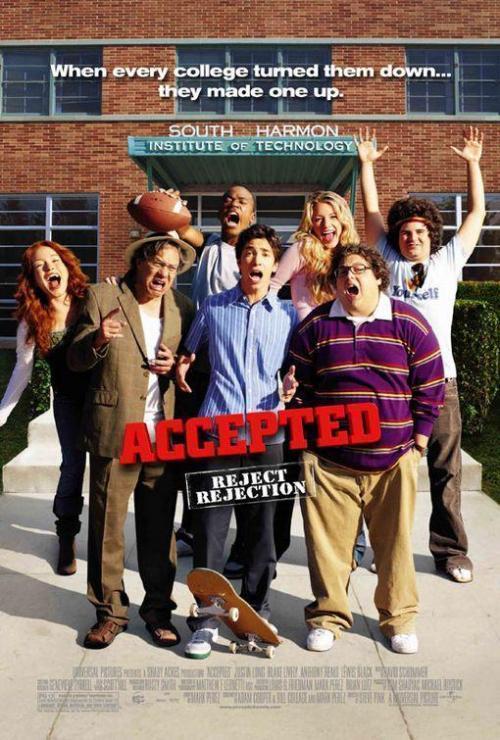
In one scene from the college comedy film Accepted, the dean of an elite fictional institution, Harmon College, is having a private meeting with one of the school’s fraternity leaders. “Do you know what makes Harmon a great college?” the dean asks the student.  “Rejection.  The exclusivity of any university is judged primarily by how many students it rejects.”  With its crimson colors and prominent “H” in the design Harmon College is clearly meant to invoke Harvard University as a representation of all the prestige and privilege of America’s traditional colleges and universities.  On the flipside is the South Harmon Institute of Technology (yeah, that’s right.  S.H.I.T.) a school started on a lark by young Bartelby Gaines (Justin Long) when he got rejected from all seven schools he applied to, including Harmon.  These ideas of “rejection” and “acceptance” recur throughout the film.  Harmon College is predicated on rejection while South Harmon Institute of Technology is the place of acceptance.  During an impromptu assembly at the new South Harmon, Bartelby Gaines realizes he is in front of an auditorium full of lovable losers like himself, people who didn’t make it into the school they wanted and who just wanted an opportunity to go to college somewhere, anywhere.  He then gives a fiery speech to this audience of rejected students telling them, “We accept you!  We accept your flaws!”

I’m not sure about the background of the screenwriters or the director of this film, but clearly someone involved in this project was familiar with the for-profit college industry.  Accepted was released in theaters in 2006 but didn’t do all that well at the box office.  Perhaps people saw it as just another stupid college movie, and yes, at times it does play out like so many of these silly formulaic college comedies.  But behind the predictable frat jokes and sophomoric toilet humor is a film that comes close to brilliance in the way that it captures the spirit and ideology of for-profit colleges.

The film mostly follows the story of Bartleby Gaines (Justin Long, probably best known as the “Mac” guy) as he graduates from high school.  Bartleby is a lovable slacker.  He’s clearly intelligent and shrewd, but he’s also a lackluster student.  While Bartebly gets rejected by every college that he applies to, his best friend Sherman (Jonah Hill, star of Superbad) gets accepted to his dream school, the prestigious Harmon College.  To avoid disappointing his parents Bartleby hatches a scheme to fabricate an acceptance letter to a fake school.  He enlists the computer whiz Sherman to help him design a realistic-looking website for the institution.  When Bartleby realizes that he will need an actual physical campus to keep the ruse going, he finds an abandoned psychiatric hospital near Harmon College and renovates it to look like a college campus. He then gets his uncle Ben Lewis (the great comedian Lewis Black) and has him pretend to be the Dean of the college. Ben is a washed up alcoholic who dropped out of grad school years ago, and his rants about the lies of higher education (in typical Lewis Black style) are some of the best moments in the film.

At first Bartelby put up the website just to fool his parents.  But he is shocked to realize other people also visited the website, and on the first day of classes hundreds of students pour into the school with $10,000 tuition checks in hand.  That’s when Bartleby figures out maybe this starting up your own college thing isn’t such a bad idea.  Thus the South Harmon Institute of Technology is born, welcoming these self-proclaimed “SHITheads”, these students who also did not get accepted into traditional colleges.  South Harmon Institute of Technology becomes the scrappy underdog we root for, and all those snooty elitists at Harmon College are just trying to block their shine.

The circumstances around the founding of South Harmon are not exactly that of a for-profit school like University of Phoenix.  Real life for-profit colleges are backed by investors and were started from the beginning with the idea of maximizing profits.  However, Accepted does manage to tap into the image that for-profit schools project about themselves, and I think the film inadvertently offers up a cautionary tale to those of us interested in preserving public higher education.

It is important to see that for-profit colleges are not just about finding ways to make colleges profitable, and not just about applying market rationality to higher education by arguing that the bottom line benefits all.  No,  for-profit colleges have been as successful as they have been so far because they have found ways to tap into the hopes and dreams of people struggling to give themselves a better life.  Their spiritual message is one of acceptance.  In their propaganda, all for-profit colleges are plucky startups like South Harmon Institute of Technology and all traditional colleges (private or public) are crusty elitist spoil-sports like Harmon College.  Here in New York City the subway cars are full of for-profit college ads persuading people to get a college degree no matter if they have kids or are already working two jobs.  We will accommodate your needs, they say.   The traditional college is elitist and exclusionary, while the for-profit school is democratic and non-judgmental

This should come as no surprise.  Thomas Frank’s political bestseller What’s The Matter With Kansas explored how the right wing has endeared itself to the very working class that it has spent most of the last three decades disenfranchising and undermining through unregulated casino capitalism and aggressive anti-union tactics.  The for-profit college phenomenon is simply the latest chapter in a long history of Wall Street exploiting and undermining the American working class while selling them a false sense of empowerment.

The PBS Frontline documentary College, Inc. pointed to some of the numbers that have raised concerns about what is happening in the for-profit college industry.  20 billion dollars of federal loans and grants have been used by students to attend for-profit colleges. (i.e. these profitable companies have been built through those dastardly “government handouts”)  Today for-profits account for 10% of the nation’s college students, but consume 25% of the federal aid.  Defenders of the for-profit colleges rightly point out that student loans have been soaring out of control at the traditional colleges, so it’s hardly fair that for-profits should take all the blame for this financial problem.  They are right.  Student loan debt overall is a $750 billion dollars, roughly equal to the entire amount of credit card debt in the U.S.  However the problem is that for-profit colleges account for 10% of the nation’s students, but account for 44% of the loan defaults.  These are the makings of another destructive financial bubble, maybe one just as ruinous as the housing market crash.

And I’ll concede the for-profits another point: If anything they have only accentuated the extortionist practices already present in the traditional colleges.  For instance, traditional colleges have cut deals with textbook companies that force students to pay for books at exorbitant costs.  In my own field of English, students are forced to pay $60 a pop for crappy composition readers they’ll probably never read again, mainly because they are full of worthless insipid articles from Newsweek passed off as models of good writing.  Tuition and fees are going through the roof year after year.  This is all done knowing that most students will just accept these burdensome costs as the necessary evil of higher education.  The students increasingly rely on loans and credit cards to cover the costs and keep compounding their debt in order to stay enrolled from year to year.

One of the key moments for me in College, Inc. comes near the end in an interview with Mark DeFusco, a former administrator at the University of Phoenix.  When asked if education should be a business, DeFusco paused for a beat or two, then said: “I’m happy that there are places in the world where people can sit down and think.  We need that.  But that’s very expensive.  And not everybody can do that.  So for the vast majority of folks who don’t get that privilege, then I think it’s a business.”

I know documentary editing can be misleading, and any stray quote can be pulled out as a “gotcha” moment.  But I do think DeFusco articulated something that is particularly disgusting about the for-profit schools: This thinly veiled contempt and condescension towards the very students who come to their schools.  The idea that the humanities are all fine and good for well-off students, but a waste of time for poor students is one of the principle ways that the for-profit schools can and will end up reproducing the very inequality that they claim to be eradicating.  The lofty world of ideas is fine for students from wealthy backgrounds, but the poor need “practical” skills.  It’s fine for all those rich kids to develop the ability to think creatively, to question age-old assumptions, to develop the kind of historical sensibilities and knowledge necessary for participation in a democracy – but we need to put you poor people to work, not fill your head with all these high-falutin’ ideas.

In fact what they are saying is that working class students are not even worthy of the vaunted Western tradition of Great Ideas that conservatives in the 1980s were trying so hard to defend from all those “intellectually bankrupt” and “therapeutic” multiculturalists.  Again, we have one of those shrewd reversals: it is now the Right and the for-profit colleges who claim to be the champions of multiculturalism.  If you let them tell it, Wall Street is the only entity in America really standing up for the rights of minorities to receive an education.   And now, they argue, it is at the traditional college where the administrators stand in the doorway of the school, like George Wallace in Tuscaloosa, refusing to allow hardworking black and brown students access to higher education.

This is where I think Accepted unintentionally hit the nail on the head.  The administrators and defenders of actual for-profit colleges know that many Americans see traditional colleges as elitist and exclusionary (even when at public schools like CUNY, people have been fighting for years to have wider, affordable access to higher education). If we are not careful we will hand the for-profits exactly this type of pseudo-populist energy that Bartleby wins among the students at South Harmon.  And I think it is especially important that in our critiques of for-profit education that we do not demonize the students who have chosen to pursue their education at these schools.  Defenders of for-profit education love to use their students as human shields to deflect criticism, as if anyone who has a problem with for-profit education really has a problem with these hard-working students who just want to go to college.

In recent months there have been numerous rallies to defend public education. Over the last few weeks Europe has exploded with student protests against budget cuts. Here in the U.S.  the documentary Waiting for Superman, about charter schools at the elementary and secondary level, has upped the ante and forced people to take sides in the debates about education profiteering at all levels.   However I think the movement for public education suffers from the same malaise affecting the American left as whole:  We are too comfortable playing defense.  Even after the American people elected a Democratic administration into the White House, the left was still preoccupied with the latest stupid statements from Glenn Beck and Sarah Palin, allowing them to set the terms of debate.  The result has been a weak health care reform bill with no public option, and now Obama signing a bill to give more tax cuts to the rich.  (Not to say he didn’t want to do that anyway, but that’s beside the point.  He should have been pushed in a different direction.)  In order to really make a difference for working people we can’t continue to keep relying on defensive measures.  I realize that defending education budgets as they are now is absolutely necessary.  And I respect the effort that organizers have already put in to this movement.  I just hope that while we “defend” and “protect” our public schools from further commercialization of education, that we also find a way to start talking about the expansion of public education.  We need more compelling stories about how public education has been essential to the project of democracy.  And we must push for real, affordable opportunities for students to gain access to college without a lifetime of debt.