Reality Check

BackToSchool

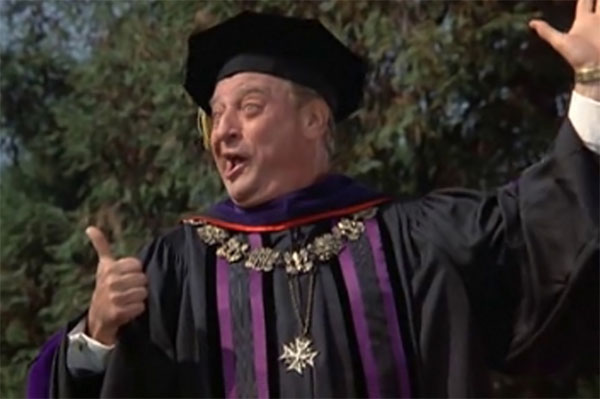
Rodney Dangerfield in “Back to School”  (1986)

I often wonder about my fellow professors who coo online about how great their classes are and how great their students are.  I wonder if what they are saying really represents the reality of their classrooms.  In some cases, their Rate My Professors page tells a very different story. (Though, yes, usually the most ignorant and laziest students are the ones leaving the harshest comments on RMP.  They’re all like “Ehrmygawd, she made us do WORK!”)

I try to avoid publicly disparaging students, though it is so very easy to go online and gripe.  I’m connected to a lot of professors on social media so I see the constant litany of venting about student behavior, and yes, I’ve contributed to it myself from time to time.  I get the appeal of complaining.  It can be cathartic to go online and scream with your friends about some of the blatantly disrespectful bullshit we put up with in classrooms, whether it’s students who email us with demands to recap classes that they missed, or students who show up half an hour late and start talking and texting, or the students who expect to get A’s for work that probably shouldn’t even be accepted in a middle school class, let alone college.

But in the interest of transparency I feel I should add a follow up to my previous posts. Looking at the evaluations from last semester apparently there were people in my classes who absolutely HATED me and hated the work.  I figured that was true of certain individuals, but it was enlightening to see it in writing.

In Contemporary American Fiction there was one student who said they hated the course and only took it because there was nothing else that fit their schedule, as if I am somehow to blame because they are too incompetent to manage their own goddamn educational program.  But whatever…

One of the most amusing comments was that “all the books were about the same topic: Black Authenticity.”   Hmm…now that’s interesting.  I didn’t realize that in the first four weeks of class when we were talking about digital media, print culture, intellectual property, and theories of the novel we were really just talking about black authenticity.  And I suspect  Kathleen Fitzpatrick, David Shields, Don DeLillo and even Teju Cole might be surprised to know that this is what their work is really all about.

You see, this is an example of what David Leonard wrote about in this article for the Chronicle.  Students often bring their own racialized perceptions to the classroom, and a different professor teaching the same books probably wouldn’t have received that comment.  But, when the black dude made you read 3 out of 7 texts by authors of color, somehow that equals “all the books were about the same thing.” Got it.  And I wish I could say such biases were limited to white students, but don’t even get me started about some of the attitude I’ve gotten from black students.

In that class, and others, there were complaints that I didn’t lecture enough.  Yes, you read that right, I did not lecture ENOUGH.  So much for all the snarky hipster pedagogues out there who keep telling us that millennials really want to be all collaborative and shit.  I had already suspected this myself, so it was nice to see the confirmation.  On the one hand, I take that as a sign the course was effective because it means they were not in the comfort zone of sitting passively and watching a professor talk.  I required them to lead the sessions in groups each week and that meant doing the kind of careful, rigorous reading that one must do in order to talk to others competently and at length about books that one has read.

But no, they do not want to take the lead and collaborate and do projects together because that means WORK.  What they really want to do is sit back and watch someone else talk while they fiddle with their phones.  Adjacent to that point were multiple comments from students in different classes demanding that the classes be more “entertaining.”  Now that’s a very telling word coming from people raised on screens and trained in the culture of amusements, isn’t it?  “Amusing Ourselves to Death” is what Neal Postman wrote about some years ago.  I always include some critical media work in every class, so there is some space for intervention there, whether any of that critique actually sinks in.

All of this has made me feel I need to rethink my strategy in the classroom.  You can drive yourself crazy smashing your head up against the brick wall of institutional cynicism in higher education right now.  Profit-driven education means that schools admit unprepared, apathetic, insolent students and demand that professors teach these folks who are clearly uninterested in any kind of serious work.  It also means many of their professors are contingent laborers who don’t have the time or resources to teach them competently even if they wanted to.  But the students keep showing up with tuition checks so we’re required to “serve” them.  Too often, higher education today feels like a parody of college.  All the buildings are there, and there are people walking around, but it might as well be an elaborate movie set with actors, because there is little in the way of serious instruction and education going on.

OK maybe I’m romanticizing my own experiences.  Yes, Morehouse is an unusual place, and I was a diligent student and I associated with other students who were competitive and we challenged each other.  At the same time, there were also people around us going through the motions.  When I went back to campus a few years ago for a professor’s retirement symposium, the most common complaint among my former professors was student apathy.

It sounds old-fashioned, I know, but learning really does require discipline.  The way to really get results out of students is to demand a certain level of discipline from them, and I’m seeing that this is impossible in many cases.  There is a baseline of effort necessary from a student in order to teach them anything.  You can be the greatest music teacher in the world, but if you have a student who refuses to practice scales at home, then there is nothing you can teach that student in the one or two hours you are together each week.  A great coach cannot train an athlete who only shows up to practice and won’t work out on her own.  A mathematician cannot teach math to someone who won’t work on problems sets by themselves.  And so forth…

Part of our job as teachers is to coax that effort out of them, and I do that by having certain expectations of participation, and making those expectations clear from the very beginning.  Ultimately the goal is to get them to take over their own learning process and learn how to teach themselves. But that is very difficult in a situation where apathy is the accepted norm.  I’d love to run a classroom where if a student hasn’t shown up two or three classes into the term, then that student gets dropped.  But no, no. We have to let them in the class because they paid, and so now you get someone who missed all of the things I went over in the first two classes, hasn’t bothered to read the syllabus, and now I’m forced to waste time and energy and interrupt the flow of my class by repeating myself and going over the most basic shit that we already covered.  And rarely do these stragglers turn out to be eccentric future Rhodes Scholars.

We get students who are so apathetic that they won’t even buy a book (not even an inexpensive one) and won’t read anything, and turn in papers that completely ignored everything we went over in the class.  And please don’t give me that open-source crap, because I post free texts on Blackboard all the time and they don’t read that either.  Despite spending days going over research methodology I still got “works cited” pages that were nothing but numbered list of weblinks.  Twice last semester during research paper draft workshops – TWICE – I had students ask if they could leave since they hadn’t bothered to do the work.  (My answer: Of course you can leave whenever you want to, This is college!  There are consequences to every decision, but you’re never required to be here if you don’t want to be.)

I mean, what do you do with that kind of apathy?   I just don’t know.  I’m mystified by it, and I don’t understand it.  Why would a person keep showing up to do something they are so uninterested in doing?  Why does that person not have the guts to leave, go out and do whatever it is they believe is more important?  These are spiritual questions really, and I’m neither a priest nor an imam, so I can’t help with that.

On the other hand, I do understand.  Such students are the ideal customers for a profit-driven college system.  They’re sleepwalkers.  Rudderless.  Directionless.  They’ll show up with tuition money year after year, drag their educations out five, six, seven years, keep buying books and school paraphernalia, and food from the food court, and will get very little out of the experience.  Unfortunately, they occasionally do show up in classrooms, and we are expected to find ways to teach them even when they act like requiring the tiniest bit of effort from them is a human rights violation.

Yes, there are some who are worth the effort.  I have had some excellent students over the years, and there were some amazing students who did great work last term and and who I could see have potential to do great things in whatever fields they choose.  Those are the students I try my best to show up for and give a good class because they deserve to have a professor who can challenge them and make them better.  And occasionally if other classmates of theirs want to show up and make an effort along with them I am always willing to help anyone who at least tries to do the work.  Plenty of students have passed my classes over the years who probably shouldn’t have, but that was because they at least tried to do the work, and I’m not interested in screwing people over when I know they are making a real effort.  Because in making that effort, at least there is some learning taking place.  It may not be the ideal outcome I want, but the very practice of writing and reading will at least help them to develop these skills.

So I just wanted to add a dose of reality here if I’m going to be writing about pedagogy on this blog.  I usually try to avoid negativity and I am always conscious of protecting student privacy.  Mostly, I post my educational material here because, well, I’m a teacher. I want to share the knowledge from these courses with others who might be interested in the subject matter, and who might get ideas for teaching their own classes.  I know I’ve learned a great deal from what other professors post about their classes, and in many cases I’ve directly incorporated lessons, strategies and course policies I’ve found from other professors online.

So I felt like I needed to clarify, and yes, to vent a little bit, but from here on out I’ll try to keep things positive.  But believe me, when you read anything about classes on this blog, even when I do not say so explicitly, you can rest assured it was not written through the lenses of rose-colored glasses.

Obsolete? The Novel and the University in the Digital Age

Last semester’s course on Contemporary American Fiction turned out to be a success, with good effort and engagement from the students and interesting conversations each week.  It was a “hybrid” course, my first time teaching in such a format. The course met in person Mondays, and online on Wednesdays.  I was skeptical, but the format actually turned out to be fruitful and relevant to the subject matter of the course, which I gave the subtitle “Obsolete?: The University and the Novel in the Digital Age.” The course itself turned into a mixture of short-form digital writing (with discussion board conversations each week), long-form reading (five novels altogether) and more polished, formal writing (with short review essays due every two weeks).

With the online discussions on Wednesday it was obvious some students were just phoning it in with perfunctory responses to the first comments they came across. But I let that slide. Just putting some words together each week was good practice in developing a discipline of reading and writing.  Serious writers learn to write consistently whether they “feel like it” or not, and I think that’s what they were learning to do with the weekly assignments.

So I wanted to record a few thoughts about the books we covered:

anxietyofobs

The Anxiety of Obsolescence –  I assigned this book to add some more theoretically dense critical writing than the students might be used to.  Fitzpatrick’s book was one of the main texts I had in mind for this course when I designed it.  The very form of the text that we used, Fitzpatrick’s own online version of the book, is a clever experiment in merging theory and practice.  Much has changed since 2006 when it was published.  The collapse of bookstores, even the corporate chains, and budget cuts to libraries shows that fears of obsolescence are not entirely unfounded.  But I liked the way that Fitzpatrick unpacks some of the cultural meaning behind declarations of obsolescence; mainly that they often come from gatekeepers (yes, often straight white men) who find their power and influence being challenged by the hordes of commoners. Again, the  Ferguson protests are another instructive moment. Others have already written about the way that women, and women of color specifically, have wielded social media and used it in interesting ways politically and intellectually, and how they have often encountered vicious responses in these digital spaces.  There’s so much hostility directed at women who have followings, so much resentment that certain women are being listened to and read, and so much of that male anger is driven by the assumption that these women do not deserve such platforms, and that merely reading and listening to them is somehow culturally and politically dangerous, and that therefore these women must be put back in their places and silenced.  Fitzpatrick’s book is a welcome corrective to the reactionaries who warn us that new digital forms are destroying literature, journalism, or intellectual discourse, and she provides a convincing analysis of the sinister cultural politics lurking in those critiques.

realityhunger

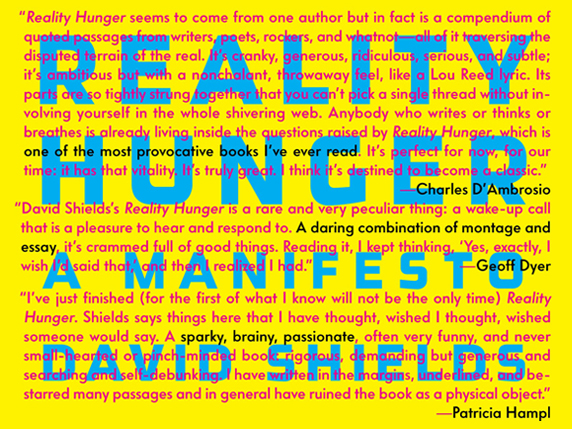
Reality Hunger – I know Shields’s book is a gimmick, and there might be other theorists who I could have assigned to get the same critiques into the conversation, but mostly the book was an effective and engaging introduction to some basic ideas about copyright, intellectual property, digital reproduction and writing.  The students mostly resisted his skepticism about the form of the novel.  As wired as they are, they are also not averse to all long form reading.  After all, this is the generation raised on Harry Potter, and raised on the revived interest in say, Lord of the Rings or Chronicles of Narnia.  Those examples of fantasy writing speak to Shields’s biggest blind spots.  Yes, reality-TV and mockumentary and memoir are prevalent forms, and he gives some sound arguments (by cobbling together the words of others) about why these forms dominate in a digital culture.  But the continued popularity of science fiction, fantasy, vampire, romance and supernatural novels (among other “genre” writing) seems to suggest that there’s still a thirst for fantastic fiction in literary form, and that the generation of social media seems to be interested in more than thinly veiled autobiographical forms of their own lives.

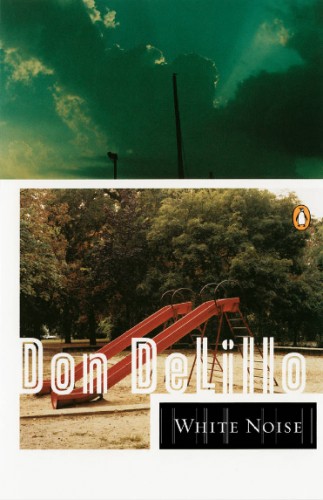
white-noise1

White Noise –   I have written about this novel before (“Reading DeLillo’s White Noise in the Summer of Ferguson”) and I thought what I put down about was pretty darned perceptive especially in light of the Black Friday protests that came about later. (Though I didn’t take the argument far enough.)  Many people have complained about the venal consumerism of Black Friday, the sacrilegious corporatization of a sacred Christian holiday, and the awful spectacle of people being trampled to death for cheap electronics.  Despite all of this, it was last year in 2014 that we really saw the first substantial pushback against the gluttonous consumption of the Christmas shopping season.  Black activism did that. And the Ferguson movement brought into stark relief the ways that American consumerism can (and will) be weaponized against movements for justice.

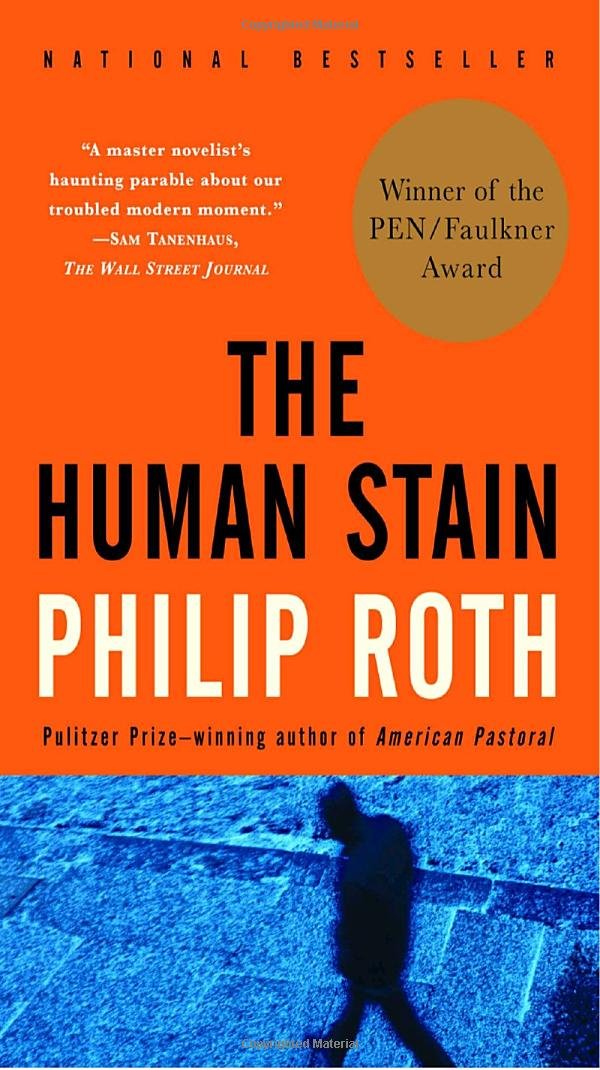
thehumanstain

The Human Stain – Reading this book again deepened my appreciation for Philip Roth’s writing.  Yeah, yeah, I know he’s a misogynist prick and I’m not supposed to like him. Yeah,  I watched the PBS documentary Philip Roth Unmasked a couple of years ago when it came out and it occurred to me how many male novelists he cited as exemplars of the form.  But he is undoubtedly important, and much of his writing is genuinely insightful.  Even from a feminist perspective, a novel like The Dying Animal captures so well the changes that the movement brought to the culture of college campuses.  Clearly Roth did his homework about the African-American experience in The Human Stain, capturing the drama of a black family living on the edge of the color line.  The book also articulated so well that hysteria of the Clinton-Lewinsky moment, a moment, which by the way, fell into the realm of “history” for my students.  (Most of them were too young to remember when that was all going down.)  The discussion board conversation about The Human Stain was one of the best, as we talked about the concept of “passing” and racial identification.  My perception of their comments is that they were indicative of a generation raised on consumerism, and trained in the language of choice.  Their consensus about Coleman Silk’s decision to pass for white was that people should be able to choose to identify however they want.  Nevertheless, I also pushed them to consider the ways in which race is embedded in particular histories of white supremacy and anti-blackness, a history which complicates the seemingly benign concept of “choice.” The idea that there are things we cannot choose seems to offend the sensibilities of the young, but understanding the difference between those identities you can and cannot choose is the beginning of empowerment and understanding.

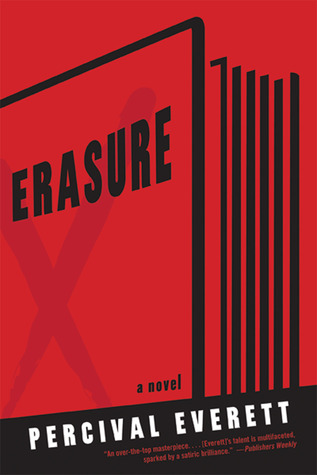
erasure

Erasure  – I wasn’t sure how this novel would go over, but it turned out to be one of their favorite books.  Their reactions to it were interesting.  The centerpiece of the novel is My Pafology (later retitled Fuck) a satirical novel based on the plot from Richard Wright’s Native Son, and a parody rife with exaggerated caricatures of the black underclass. I was surprised that some of them found the backstory about literary fiction writer Theolonious Ellison less interesting and less funny than My Pafology/Fuck, but I suppose that is precisely the irony that Everett was going for, and maybe that reaction only serves to reaffirm what Everett was writing about in the first place, and shows how brilliant this novel really is. I shared with them some of my own writing on the book, and I think we had a good conversation about minstrelsy and the fraught history of black cultural performance in a white supremacist culture industry.  Last year another of Percival Everett’s academic novels, Glyph was republished by Graywolf Press.  I will be discussing both of these novels at the upcoming NeMLA meeting in Toronto in early May.

onbeauty

On Beauty – This is a novel that really deserved more than two weeks of discussion.  The students struggled to get through it and I’m sure some of them cursed me for assigning it since it was so long, but mostly they seemed to enjoy it.  I admit I was skeptical about this novel after my first reading a few years ago.  Reading it again, however, I saw the beauty and power in Zadie Smith’s writing, and there were so many great passages I wanted to linger over but couldn’t do so in my push to get through. (Full disclosure:  I’m working on a longer piece about it, so I will have several chances to re-read it again.) The book really does dig into and occupy the academic novel genre.  I would not be at all surprised if it turns out Smith read several of them before composing this one.  On Beauty hits all the conventions of the genre, but delivers them in a fresh and even subversive way.  I loved Smith’s beautiful descriptions of the physical geography of academic spaces, and she nails the absurd pettiness of academic politics.  While reading this novel I also read Smith’s compelling new short story published last year “Miss Adele Admist the Corsets” an inventive take on gentrification-era New York told through the story of an aging drag queen. (The full story was temporarily available on the The Telegraph.)

opencitytejucole

Open City –  Well, this was a colossal flop.  They HATED this book.  I have to admit; I miscalculated.  Mainly, I think I let my inner New York historian take over and distort my vision of the novel. One of the things that Cole has been so highly praised for with Open City is the novel’s rich, perceptive take on the geography and history of NYC.  Without that context, yes, a reader might see it as just some book about a dude wandering around, seeing random shit and thinking deep thoughts about it.  I did mention that this was in the tradition of the flâneur, and one student happened to be reading Baudelaire in another class.  Despite the negative reactions to it I’m still glad we read it because Cole provided us with a different approach to the novel.  We listened to this interview with Cole where he described Open City as an “idea-driven” rather than “plot-driven” novel, and that seemed to help clarify things a bit.  They still didn’t like it, but I felt like we got an interesting conversation out of it, and selfishly, I was glad to re-encounter what I still think is a luminous and important piece of 21st century writing.   And pedagogically, I felt it became a useful exercise in how to write intelligently, thoughtfully and fairly about a work one doesn’t like.

Along the way we talked about the politics of higher education, and some conventions of the academic novel, and we read Jeffrey Williams’s article “Teach the University.”  I think we fulfilled that concept of teaching the university in this class, by addressing some of the pertinent issues in higher education in our readings of these novels.

No, I don’t have any grand pronouncements about obsolescence to conclude with, but whatever the outcome, the future of the novel and the university is in the hands of the next generation, and I am not without hope.

Reading DeLillo’s White Noise in the Summer of Ferguson

white-noise1
Reading DeLillo’s White Noise in the Summer of Ferguson

This summer I endeavored to knock a few books off the old “should-have-read-it-a-long-time-ago” list.  Don DeLillo’s White Noise is one of those academic novels that I’ve name-dropped plenty of times before, but still had not read.  So, in early August, comfortably ensconced in my new digs in Jersey, I sat down and dug into it.  A couple weeks later, just before the start of the semester, I found myself assigned to teach a course on Contemporary American Fiction. I quickly assembled a syllabus that included White Noise and leaned heavily toward academic novels, including The Human Stain, On Beauty, Erasure and Open City.  (OK, Open City may not be an academic novel exactly, but I’m hoping that reading it again will help me decide).

While reading White Noise, I was also keeping up with the escalating situation in Ferguson, Missouri after the killing of Mike Brown on August 9.  Like so many other folks on Twitter I watched what started as a steady stream of tweets by people on the ground in St. Louis turn into a national and international story.

When I came to the end of Section II of White Noise the infamous “Airborne Toxic Event” chapter – I immediately noticed correlations to what I was watching unfold on social media.  The main character of White Noise is Jack Gladney, professor of “Hitler Studies” at the College-on-the-Hill. (Gladney can’t read or speak a lick of German, by the way). Jack, his fourth wife Babette, their three kids, along with their neighbors, have been evacuated from their suburban homes because of a train car spill that has left a mysterious toxic cloud hovering in the area.  Section II ends with the family in a building in nearby Iron City, housed with other evacuees. A man with a small, portable TV set walks around the building and goes on an epic tirade about the media and how it has neglected their plight:

Don’t they know it’s real?  Shouldn’t the streets be crawling with cameramen and soundmen and reports? Shouldn’t we be yelling out the window at them, ‘Leave us alone, we’ve been through enough, get out of here with your vile instruments of intrusion’…What exactly has to happen before they stick microphones in our faces and hound us to the doorsteps of our homes, camping out on our lawns, creating the usual media circus?  Haven’t we earned the right to despise their idiot questions? (162)

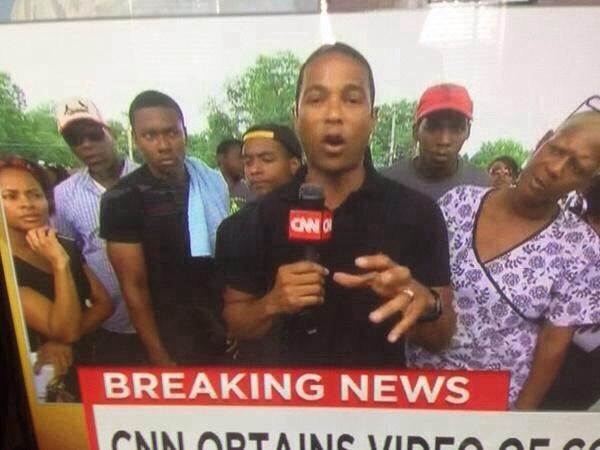
Is this not exactly how things went down in Ferguson?  First there was an outcry that mainstream media was neglecting the story.  But once that mainstream media arrived, and acted like its obnoxious mainstream media self, then came the outcry for the reporters to leave.  The media spectacle produced one particularly indelible image of CNN’s resident black pathologist Don Lemon, surrounded by a group of St. Louis residents giving him mad side-eye.

donlemonferguson
In fact, the media mess got so bad that journalist Ryan Schuessler voluntarily left the scene, and poignantly explained his reasons for doing so, citing the arrogant selfishness of the talking head divas who parachuted in and immediately started throwing their weight around.

In my class I assigned part of Kathleen Fitzpatrick’s The Anxiety of Obsolescence to read along with the novel.  Chapter 3 of the book, “Spectacle,” is specifically about DeLillo’s work, and Fitzpatrick uses some noteworthy media theorists (Postman, McLuhan, Baudrillard, among others) to pick apart the media critique in the novel (while also remaining suspicious of how discourses of obsolescence deployed by straight white male writers are too often imbued with specific racial and gender politics). One of the great things that White Noise does so well is to show the discomfiting ways televisionized populations have come to rely on mainstream media narratives to validate their suffering.  From the Airborne Toxic Event, to the people on a terribly turbulent plane ride that managed to make it to the ground unscathed, the novel shows characters repeatedly turning to television news to narrate and give meaning to their own traumatic experiences.

This is a particularly dangerous game for black folks when corporate media is as  hostile to black life as it is.  (Yes, even that so-called “liberal” media who covered the event deflected conversations away from the injustice of a police murder and toward tired, insulting debates about sagging pants and black parenting).  That media attention is a terribly recursive loop that is difficult, maybe even impossible, to escape.  Attracting national attention was absolutely essential to the growth of the Ferguson movement and has resulted in an international outcry against the Ferguson police and their malicious mishandling of both the shooting and the protests. (Their hostility and incompetence are not even up for discussion).  At the same time, Don Lemon and the rest came swooping onto the scene with their “idiot questions” about black behavior, because they know those hot-button topics will generate the predictable ratings numbers and page views that they need to satisfy their advertisers.

White Noise is also a novel that begs to be read through the critical lenses of race and class privilege.  In my own classroom it took a while for students to get around to it – I’m getting better at shutting up and letting them talk things through on their own – but eventually, they hit the key points about race and class that were staring us all in the face.  Clearly these characters are folks whose anxieties, fears and consumption habits are not universal, but are directly related to the level of comfort and privilege that they take for granted.  When the cloud first forms, and before they ever considered having to evacuate, Jack Gladney says:

These things happen to poor people who live in exposed areas.  Society is set up in such a way that it’s the poor and the uneducated who suffer the main impact of natural and man-made disasters.  People in low-lying areas get the floods, people in shanties get the hurricanes and tornadoes.  I’m a college professor.  Did you ever see a college professor rowing a boat down his own street in one of those TV floods?  We live in a neat and pleasant town near a college with a quaint name.  These things don’t happen in places like Blacksmith. (114)

That passage conjured images in my mind of the horrors of the 5th ward during Hurricane Katrina, and the projects in Red Hook and Coney Island during Hurricane Sandy (among many other unfortunate scenes).  I noticed some early reviewers of White Noise cited the Bhopal disaster in India, which happened in December 1984, just a few weeks before the novel hit bookstores in 1985.  Bhopal was a real live Airborne Toxic Event, except there were no fancy microbes to clean up the air, and people are still living with the after-effects of the company’s callous negligence some 29 years later.

But I now think about the story of David Hooks– a 59 year old white man in Georgia  – who on September 24 was killed by DEA agents who barged into his house with a no-knock warrant.  No drugs were found.

Surely such things only happen to people in the hood who voluntarily choose to live around drug dealers, right? Surely such things do not happen to polite law-abiding white citizens, do they?  As the Ferguson story grew, white nationalists found a cause celebré in Darren Wilson, raising over a half million dollars (to date) for his legal defense (and, apparently, for lap dances and beers, at his discretion).  But more level-headed white folks have (hopefully) looked at the body armor and tanks and tear gas on the streets of Ferguson and have realized that the urban militarism deployed against the protesters there won’t stay confined to the hood for long. Hopefully they realize now (if Occupy Wall Street didn’t show them before) that all those chickens that people have warned about – perpetual wars in other places leading to escalated militarism in police forces domestically – have indeed come home to roost.

For the most part our conversations about White Noise in class didn’t get this politically topical.  Again, I tried to stay out of the way and let them think their own way through it.  We did talk about race, religion, class and gender.  But they also spoke quite eloquently about the age of television and how televisual media has come to dominate our self-perception. They talked about fear of death in the novel (one of its biggest topics given the whole storyline with the experimental drug Dylar that Babette is taking to quell her death fears), and I was proud to hear them deal with a such a heavy and discomfiting topic with maturity, intelligence and humor.

Consumerism was another one of the big themes we lingered on.  There’s a lot of shopping in the book. DeLillo eschews the pastoral in favor of the bright, sterile artificiality of shopping malls and supermarkets.  In one rapturously written scene set in a massive shopping mall DeLillo writes:

We moved from store to store, rejecting not only items in certain departments, not only entire departments, but whole stores, mammoth corporations that did not strike our fancy for one reason or another.  There was always another store, three floors, eight floors, basement full of cheese graters and paring knives.  I shopped with reckless abandon.  I shopped for immediate needs and distant contingencies.  I shopped for its own sake, looking and touching, inspecting merchandise I had no intention of buying, then buying it.  I sent clerks into their fabric books and pattern books to search for elusive designs.  I began to grow in value and self-regard.  I filled myself out, formed new aspects of myself, located a person I’d forgotten existed.  Brightness settled around me. (83-84)

Here then, is the 21st century.  Maybe it has always been this way.  On one side of town an unarmed black teenager takes six bullets to the body and the head from the gun of a policeman, his lifeless corpse left to rot in the street for hours afterward, the officer who shot him filing no report, and charged with nothing.  Meanwhile, on the other side of town people go from store to gleaming store, shopping for cheese graters and paring knives, feeling good about themselves and their comfortable lives.  The dread of White Noise, the dread that the shoppers try to placate with their shopping, is that maybe the boundary between these two sides of town is far more permeable than they want to admit, or imagine.

DeLillo, Don. White Noise. New York: Penguin, 1985.

Fitzpatrick, Kathleen.  The Anxiety of Obsolescence: The American Novel in the Age of Television.  Nashville: Vanderbilt University Press, 2006.

Swamped!, or Why I Haven’t Mentioned That Jacobin Link on My Blog Yet.

We are into the second week of the semester, and last night I finally got my fourth class off the ground with our first meeting. (It’s a composition class that meets once-a-week in the evening.) So now, all four classes are up and running.

I’ve been so preoccupied with beginning of the semester tasks, and adjusting to a new institutional bureaucracy, that I haven’t had a moment to acknowledge that over the weekend my interview with David Parsons on his podcast The Nostalgia Trap was featured in Jacobin magazine.

jacobinBMIC

(Hello to all new readers who may have wandered over here from there!)

I actually felt a bit embarrassed about the attention because I haven’t been posting much lately. (And also, because I always sound like a moron in interviews.) But I’m working on a few things, and once I get some lesson plans set up I’ll get back to posting  here.

Another reason why I didn’t post here that much over the summer is because I’ve been working on getting some writing submitted to more, ahem, “legitimate” publications. I know full well that I’ll have very little chance to keep on teaching unless I get some articles placed in academic journals…which I have to do so that I can get more jobs that will require more teaching, but whatever.

Of course, I would much prefer working on the kind of writing that, ya know, people actually read. But, this is how the “industry” works, and plenty of other people have put in their work slaving away for JSTOR, so who am I to complain? Unfortunately, the rejections are already rolling in, and that’s annoying. Not only do I have to put energy into articles that won’t even be available for another three or four years, and even then, will be shielded behind university paywalls so most people can’t even read them, but the academic gatekeepers keep shitting all over my work, so I can’t even give away all this free labor!

But I’m not discouraged. Actual writers seem to like my work and have given me encouragement, even if the academics don’t, so I can live with that.

I do need to put some energy into building a book manuscript though, and that’s a project that I am actually interested in and believe in. So between that and teaching four classes there might be less time for book reviews and other items posted here.

That said, I’m really interested in the things that I’ll be teaching this semester, and I’m in the fortunate position that I can build my classes around topics that I’m genuinely interested in. I’m teaching two compositions courses, one course on African American Poetry, and one course on Contemporary American Fiction. (The latter class is built around academic novels and questions of literary and institutional obsolescence). Speaking of those classes, I’ve posted some abridged versions of the syllabi here under the new “Teaching” tab, and I’ll be posting some more things from the classes this semester.

So, there’s my update for now. The saga continues.