Afro-American Studies 198: The Black Man in the Cosmos

I’m talking about something that’s so impossible it can’t possibly be true.  But it’s the only way the world’s gonna survive, this impossible thing.  My job is to change five billion people to something else.  Totally impossible.  But everything that’s possible’s been done by men, I have to deal with the impossible.  And when I deal with the impossible and am successful, it makes me feel good because I know that I’m not bullshittin’. – Sun Ra

Many thanks to Kazembe Balagun, outreach coordinator at The Brecht Forum, for posting a note on Facebook with the actual reading list from “Afro-American Studies 198: The Black Man in the Cosmos” a course taught by Sun Ra in the spring of 1971 at UC-Berkeley (and the inspiration for the title of this blog).

John Szwed’s wonderful biography Space is the Place: The Lives and Times of Sun Ra, is an impressive study of Sun Ra’s work (no small feat since Ra could be a difficult character to get a handle on). A good brief introduction to some of Sun Ra’s recording is this short guide written by Szwed in the Village Voice.

In Space is the Place, Szwed listed the works Sun Ra assigned in the Berkeley course and described the course this way:

“Although a respectable number of students signed up, after a couple of classes it was down to a handful…But a large number of local black folks regularly attended, always distinguishable from the students by their party dress.  The classes ran like rehearsals: first came the lecture, followed by a half hour of solo keyboard or Arkestra performance.  But it was a proper course – Sun Ra had after all trained to be a teacher in college – with class handouts, assignments, and a reading list which made even the most au courant sixties professors’ courses pale.”

The Egyptian Book of the Dead

Bill Looney, Radix (a book of astrology)

Alexander Hislop, Two Babylons

The theosophical works of Madame Blavatsky

The Book of Oahspe

Henry Dumas, Ark of Bones and Poetry for My People

Black Fire: An Anthology of Afro-American Writing, edited by Leroi Jones & Larry Neal

David Livingston, Missionary Travels and Researches in South Africa

Theodore P. Ford, God Wills the Negro

Archibald Rutledge, God’s Children

The spring 1971 issue of Stylus (vol. 13, no. 1), a black literary magazine of Temple University

John S. Wilson, Jazz: Where It Came From, Where It’s At.

Yosef A. A. Ben-Jochannan, Black Man of the Nile and His Family

Count Volney, The Ruins, or, Meditation on the Revolutions of Empires, and the Law of Nature.

The King James Bible (which was listed on the syllabus only as “The Source Book of Man’s Life and Death”)

P.D. Ouspensky, A New Model of the Universe.

Frederick Bodmer, The Loom of Language: An Approach to the Mastery of Many Languages.

Blackie’s Etymology

[…and other recommended books on hieroglyphics, color therapy, the Rosicrucians, Afro-American folklore, and ex slaves’ writings.]

(pp.294-295, Space is the Place: The Lives and Times of Sun Ra.  New York: Pantheon Books, 1997)

The collection Sun Ra: The Immeasurable Equation: The Poetry and Prose is an expensive and rare anthology.  I’m saving up my pennies to get a copy at some point, but if you look at the Amazon and Google Books previews you can get a glimpse of what’s in it.  Along with Ra’s prose and poetry there is also a bibliography of his book collection compiled by Arkestra member James Jacson and other scholars after Ra left the planet in 1993.  Szwed’s biography gives a good portrait of Ra’s voracious reading habits and his insatiable thirst for books on music, history, religion, the occult, science, language and just about anything else he could get his hands on.

I’ve been especially thinking about Sun Ra’s music this week what with the uprising going on in Egypt. Of course Egypt was near and dear to his heart and its ancient history was the source of the Arkestra’s mythology.  Here’s a selection from an Arkestra concert in Egypt in 1983 with Salah Ragab and the Cairo Jazz Band.

All Power to the People.


UPDATE: You can listen to one of the lectures from the course here:
http://sensitiveskinmagazine.com/professor-sun-ra/

Japanese by Spring

I’m going to be presenting at The State of African American and African Diaspora Studies: Methodology, Pedagogy and Research, a conference co-hosted by the Schomburg Center for Research in Black Culture, and the Institute for Research on the African Diaspora in the Americas and the Carribbean (IRADAC) at the CUNY Graduate Center, January 6-8, 2011.  Here’s the full conference schedule.

Here’s the abstract I submitted for my talk:

“Black(ness) No More: Academia and the Culture Wars in Ishmael Reed’s Japanese by Spring.”

Ishmael Reed’s satirical novel Japanese by Spring (1993) is a humorous but sharply critical depiction of political debates in academia that took place in the 1980s and 1990s, commonly known as “the culture wars”.  These debates included conflicts over topics such as affirmative action, black studies, multiculturalism and feminism, all of which are depicted in the novel.  The main character of the novel is a black literature professor, Benjamin “Chappie” Putbutt III, a former Black Panther turned neoconservative, who is striving for tenure at the fictional Jack London College in Oakland, CA in the early 1990s.  This presentation is part of a larger project on academic novels and the politics of the black intellectual. I will consider Japanese by Spring as a novel that is simultaneously situated in the traditions of African-American satire (including writers such as George Schuyler, a literary influence on Reed’s work), as well as a work of “academic fiction,” a genre defined by its fictional depictions of professors and university life.

The particular panel I am on will be held on Saturday, January 8th, 10:15-11:45am, at the CUNY Graduate Center, Room C205.

Rejection, Acceptance and the For-Profit College


Accepted
(2006)

College Inc. (2010)

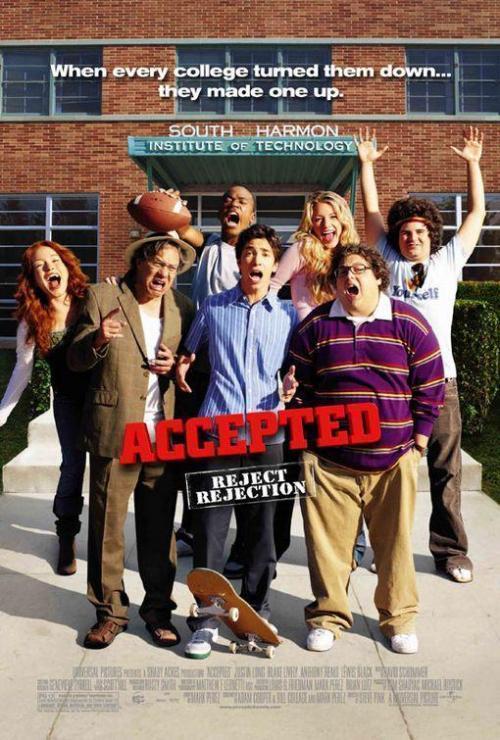
In one scene from the college comedy film Accepted, the dean of an elite fictional institution, Harmon College, is having a private meeting with one of the school’s fraternity leaders. “Do you know what makes Harmon a great college?” the dean asks the student.  “Rejection.  The exclusivity of any university is judged primarily by how many students it rejects.”  With its crimson colors and prominent “H” in the design Harmon College is clearly meant to invoke Harvard University as a representation of all the prestige and privilege of America’s traditional colleges and universities.  On the flipside is the South Harmon Institute of Technology (yeah, that’s right.  S.H.I.T.) a school started on a lark by young Bartelby Gaines (Justin Long) when he got rejected from all seven schools he applied to, including Harmon.  These ideas of “rejection” and “acceptance” recur throughout the film.  Harmon College is predicated on rejection while South Harmon Institute of Technology is the place of acceptance.  During an impromptu assembly at the new South Harmon, Bartelby Gaines realizes he is in front of an auditorium full of lovable losers like himself, people who didn’t make it into the school they wanted and who just wanted an opportunity to go to college somewhere, anywhere.  He then gives a fiery speech to this audience of rejected students telling them, “We accept you!  We accept your flaws!”

I’m not sure about the background of the screenwriters or the director of this film, but clearly someone involved in this project was familiar with the for-profit college industry.  Accepted was released in theaters in 2006 but didn’t do all that well at the box office.  Perhaps people saw it as just another stupid college movie, and yes, at times it does play out like so many of these silly formulaic college comedies.  But behind the predictable frat jokes and sophomoric toilet humor is a film that comes close to brilliance in the way that it captures the spirit and ideology of for-profit colleges.

The film mostly follows the story of Bartleby Gaines (Justin Long, probably best known as the “Mac” guy) as he graduates from high school.  Bartleby is a lovable slacker.  He’s clearly intelligent and shrewd, but he’s also a lackluster student.  While Bartebly gets rejected by every college that he applies to, his best friend Sherman (Jonah Hill, star of Superbad) gets accepted to his dream school, the prestigious Harmon College.  To avoid disappointing his parents Bartleby hatches a scheme to fabricate an acceptance letter to a fake school.  He enlists the computer whiz Sherman to help him design a realistic-looking website for the institution.  When Bartleby realizes that he will need an actual physical campus to keep the ruse going, he finds an abandoned psychiatric hospital near Harmon College and renovates it to look like a college campus. He then gets his uncle Ben Lewis (the great comedian Lewis Black) and has him pretend to be the Dean of the college. Ben is a washed up alcoholic who dropped out of grad school years ago, and his rants about the lies of higher education (in typical Lewis Black style) are some of the best moments in the film.

At first Bartelby put up the website just to fool his parents.  But he is shocked to realize other people also visited the website, and on the first day of classes hundreds of students pour into the school with $10,000 tuition checks in hand.  That’s when Bartleby figures out maybe this starting up your own college thing isn’t such a bad idea.  Thus the South Harmon Institute of Technology is born, welcoming these self-proclaimed “SHITheads”, these students who also did not get accepted into traditional colleges.  South Harmon Institute of Technology becomes the scrappy underdog we root for, and all those snooty elitists at Harmon College are just trying to block their shine.

The circumstances around the founding of South Harmon are not exactly that of a for-profit school like University of Phoenix.  Real life for-profit colleges are backed by investors and were started from the beginning with the idea of maximizing profits.  However, Accepted does manage to tap into the image that for-profit schools project about themselves, and I think the film inadvertently offers up a cautionary tale to those of us interested in preserving public higher education.

It is important to see that for-profit colleges are not just about finding ways to make colleges profitable, and not just about applying market rationality to higher education by arguing that the bottom line benefits all.  No,  for-profit colleges have been as successful as they have been so far because they have found ways to tap into the hopes and dreams of people struggling to give themselves a better life.  Their spiritual message is one of acceptance.  In their propaganda, all for-profit colleges are plucky startups like South Harmon Institute of Technology and all traditional colleges (private or public) are crusty elitist spoil-sports like Harmon College.  Here in New York City the subway cars are full of for-profit college ads persuading people to get a college degree no matter if they have kids or are already working two jobs.  We will accommodate your needs, they say.   The traditional college is elitist and exclusionary, while the for-profit school is democratic and non-judgmental

This should come as no surprise.  Thomas Frank’s political bestseller What’s The Matter With Kansas explored how the right wing has endeared itself to the very working class that it has spent most of the last three decades disenfranchising and undermining through unregulated casino capitalism and aggressive anti-union tactics.  The for-profit college phenomenon is simply the latest chapter in a long history of Wall Street exploiting and undermining the American working class while selling them a false sense of empowerment.

The PBS Frontline documentary College, Inc. pointed to some of the numbers that have raised concerns about what is happening in the for-profit college industry.  20 billion dollars of federal loans and grants have been used by students to attend for-profit colleges. (i.e. these profitable companies have been built through those dastardly “government handouts”)  Today for-profits account for 10% of the nation’s college students, but consume 25% of the federal aid.  Defenders of the for-profit colleges rightly point out that student loans have been soaring out of control at the traditional colleges, so it’s hardly fair that for-profits should take all the blame for this financial problem.  They are right.  Student loan debt overall is a $750 billion dollars, roughly equal to the entire amount of credit card debt in the U.S.  However the problem is that for-profit colleges account for 10% of the nation’s students, but account for 44% of the loan defaults.  These are the makings of another destructive financial bubble, maybe one just as ruinous as the housing market crash.

And I’ll concede the for-profits another point: If anything they have only accentuated the extortionist practices already present in the traditional colleges.  For instance, traditional colleges have cut deals with textbook companies that force students to pay for books at exorbitant costs.  In my own field of English, students are forced to pay $60 a pop for crappy composition readers they’ll probably never read again, mainly because they are full of worthless insipid articles from Newsweek passed off as models of good writing.  Tuition and fees are going through the roof year after year.  This is all done knowing that most students will just accept these burdensome costs as the necessary evil of higher education.  The students increasingly rely on loans and credit cards to cover the costs and keep compounding their debt in order to stay enrolled from year to year.

One of the key moments for me in College, Inc. comes near the end in an interview with Mark DeFusco, a former administrator at the University of Phoenix.  When asked if education should be a business, DeFusco paused for a beat or two, then said: “I’m happy that there are places in the world where people can sit down and think.  We need that.  But that’s very expensive.  And not everybody can do that.  So for the vast majority of folks who don’t get that privilege, then I think it’s a business.”

I know documentary editing can be misleading, and any stray quote can be pulled out as a “gotcha” moment.  But I do think DeFusco articulated something that is particularly disgusting about the for-profit schools: This thinly veiled contempt and condescension towards the very students who come to their schools.  The idea that the humanities are all fine and good for well-off students, but a waste of time for poor students is one of the principle ways that the for-profit schools can and will end up reproducing the very inequality that they claim to be eradicating.  The lofty world of ideas is fine for students from wealthy backgrounds, but the poor need “practical” skills.  It’s fine for all those rich kids to develop the ability to think creatively, to question age-old assumptions, to develop the kind of historical sensibilities and knowledge necessary for participation in a democracy – but we need to put you poor people to work, not fill your head with all these high-falutin’ ideas.

In fact what they are saying is that working class students are not even worthy of the vaunted Western tradition of Great Ideas that conservatives in the 1980s were trying so hard to defend from all those “intellectually bankrupt” and “therapeutic” multiculturalists.  Again, we have one of those shrewd reversals: it is now the Right and the for-profit colleges who claim to be the champions of multiculturalism.  If you let them tell it, Wall Street is the only entity in America really standing up for the rights of minorities to receive an education.   And now, they argue, it is at the traditional college where the administrators stand in the doorway of the school, like George Wallace in Tuscaloosa, refusing to allow hardworking black and brown students access to higher education.

This is where I think Accepted unintentionally hit the nail on the head.  The administrators and defenders of actual for-profit colleges know that many Americans see traditional colleges as elitist and exclusionary (even when at public schools like CUNY, people have been fighting for years to have wider, affordable access to higher education). If we are not careful we will hand the for-profits exactly this type of pseudo-populist energy that Bartleby wins among the students at South Harmon.  And I think it is especially important that in our critiques of for-profit education that we do not demonize the students who have chosen to pursue their education at these schools.  Defenders of for-profit education love to use their students as human shields to deflect criticism, as if anyone who has a problem with for-profit education really has a problem with these hard-working students who just want to go to college.

In recent months there have been numerous rallies to defend public education. Over the last few weeks Europe has exploded with student protests against budget cuts. Here in the U.S.  the documentary Waiting for Superman, about charter schools at the elementary and secondary level, has upped the ante and forced people to take sides in the debates about education profiteering at all levels.   However I think the movement for public education suffers from the same malaise affecting the American left as whole:  We are too comfortable playing defense.  Even after the American people elected a Democratic administration into the White House, the left was still preoccupied with the latest stupid statements from Glenn Beck and Sarah Palin, allowing them to set the terms of debate.  The result has been a weak health care reform bill with no public option, and now Obama signing a bill to give more tax cuts to the rich.  (Not to say he didn’t want to do that anyway, but that’s beside the point.  He should have been pushed in a different direction.)  In order to really make a difference for working people we can’t continue to keep relying on defensive measures.  I realize that defending education budgets as they are now is absolutely necessary.  And I respect the effort that organizers have already put in to this movement.  I just hope that while we “defend” and “protect” our public schools from further commercialization of education, that we also find a way to start talking about the expansion of public education.  We need more compelling stories about how public education has been essential to the project of democracy.  And we must push for real, affordable opportunities for students to gain access to college without a lifetime of debt.

James Baldwin in Obama’s America

(Originally published in the GC Advocate, October 2010)

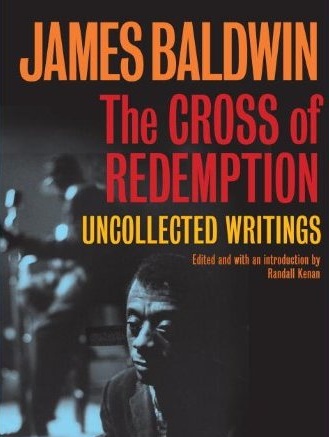
The Cross of Redemption : Uncollected Writings.  Random House, 2010.
Nearly every review I’ve seen of the Cross of Redemption so far has picked up on one particular quote from this new collection of James Baldwin’s writing.   It is the first paragraph of a piece titled “from Nationalism, Colonialism, and the United States: One Minute to Twelve – A Forum,” which is a transcript of a 1961 speech the 36 year old Baldwin gave in New York for the Liberation Committee for Africa:

Bobby Kennedy recently made me the soul-stirring promise that one day – thirty years, if I’m lucky – I can be President too.  It never entered this boy’s mind, I suppose – it has not entered the country’s mind yet – that perhaps I wouldn’t want to be.  And in any case, what really exercises my mind is not this hypothetical day on which some other Negro “first” will become the first Negro President.  What I am really curious about is just what kind of country he’ll be President of.

The quote is shockingly appropriate, not only for his comments about the potential of a black president, but also that it was given at an event on the liberation of Africa.  Barack Obama’s ties to the African continent through his father are now well known. (And will undoubtedly play a significant role again in the 2012 campaign since the “birther” conspiracies still persist.) Early in Obama’s political career, and early in his presidential campaign, he was wise enough to address his connection to Africa head-on.  It bespoke Obama’s intelligent grasp on the history of black political discourse in America. Black artists in the 1960s and 1970s, inspired by the international politics of anti-colonialism in that time, and inspired by the anthropological study of African survivals, began to re-connect with and embrace the continent and its culture.  They turned the “curse” of Ham and African lineage into a positive affirmation of global liberation.  By the next decade the black intelligentsia would be awash in kente clothe, and the term “African-American” would begin to seep into the American lexicon.  That quote also encapsulates Baldwin’s always razor-sharp analysis of race in America.  Baldwin understood that the symbolic progress of a few, especially the prospects of a black man in the White House, could very easily be used to discredit the persisting inequality among the many.

James Arthur Baldwin was born in Harlem in 1924. He was the oldest of nine children, and grew up in poverty.  His father was a strict, religious man (and actually his step-father) who was a minister of a storefront church in Harlem. Baldwin would depict this early life in the church and this troubled relationship with his father in his first novel Go Tell it on the Mountain (1953).   At the age of fifteen Baldwin accepted his own call to preach and did so for three years before leaving the church, and home, and moving downtown to Greenwich Village.  Eventually he made his way to Paris among the American expatriate community there.  He met a friend and lover Lucien Happersberger, a Swiss artist, who invited him to stay in his village in Switzerland where Baldwin completed writing Go Tell it on the Mountain.  Later, at the behest of a Turkish actor friend, he would also spend several years living off and on in Istanbul, Turkey where he completed his bestselling novel Another Country.  Baldwin was involved in the civil rights movement through marching and speaking, but became exhausted by the string of assassinations in the 1960s (“they’re killing my friends” he said in an interview once) and he spent more time in France in the 1970s.  He eventually died of cancer at his home in the South of France on November 30, 1987.

The writings featured in this collection are not entirely new.  Some of these were collected in The Price of the Ticket: Collected Non-Fiction a volume which is now out-of-print. The Cross of Redemption was compiled by Randall Kenan, a fine creative writer in his own right (author of the novel A Visitation of Spirits) and a professor of English at University of North Carolina-Chapel Hill.  It is meant to be a companion piece to the Library of America’s collection of Baldwin’s non-fiction essays by compiling other essays and interviews published in magazines over the years from 1947 to 1987.  The book reviews from the 1940s are especially interesting as they provide a look into Baldwin’s early years as a developing writer.

In his introduction Randall Kenan points out how easy it is to “pigeonhole” Baldwin as a writer who was limited to writing about race and blackness.  These were certainly subjects that Baldwin knew well, but he always wrote about them in the service of much bigger ideals.  As Kenan puts it, “…though it is too broad – if not useless – to say his true topic is humanity, it is useful to see how, no matter his topic, how often his writing finds some ur-morality upon which to rest, how he always sees matters through a lens of decency, how he writes with his heart as well as with his head.”

I would also add that in addition to head and heart, Baldwin knew the importance of the body as the site and source of human liberation.  This is the Baldwin who published Giovanni’s Room in 1954, an explicitly gay novel, now considered a classic, but which at the time was a massive risk, not only because he was a young writer, but also because this was a time when people were literally arrested for being in possession of such “obscene” material.  Baldwin understood that sex and the body were at the core of understanding American racial and political attitudes.  Reading through these essays one is never more than a sentence or paragraph away from the body, whether he is writing about the physical work of labor, the perplexities of love and sexuality, or the reality of death.   In this way Baldwin belongs in conversation with another of New York’s great writers, Walt Whitman.  Like Whitman, Baldwin knew New York City, and the nation it belongs to, backwards and forwards, from top to bottom.  Because of the circumstances of their birth – Baldwin born poor into a storefront church family in Harlem, Whitman born poor into a Long Island family full of alcoholism and disability – both writers learned what it means to be on familiar terms with a human desperation that most Americans spend their whole lives trying not to see.  Baldwin saw it all, the depths poverty in Harlem, the bright lights and glamour of the Broadway stage, the suffocating racial customs of the South, the staggering stupidity of Hollywood.  He also witnessed the perceptions of Americans abroad, in Europe (especially Paris) and in the Muslim world (particularly in Turkey where he lived off and on over a decade).

The essays in The Cross of Redemption are surprisingly fresh.  It is a credit to Baldwin’s genius as a writer that his work remains vibrant and timeless even thought he was writing about political figures and controversies that have since faded into the past.  I’ve been reading Baldwin for years, but I admit I came to this collection with the (arrogant) perception that I would somehow have to update his commentary to write about him.  I had the idea that Baldwin was a writer who, despite his split from the church, remained mired in Christian theology and yoked to a problematic notion of Christian victimhood.  I thought I would have to revise his work to account for all the political changes since his death in 1987.  I also thought I’d need to account for the growth of things like the Internet and new media, and its string of ridiculous spectacles passed off as “news.”

Nope.  Jimmy was way ahead of the game.

For instance, in “Mass Culture and the Creative Artist” Baldwin writes “The people who run mass media and those consume it are really in the same boat.  They must continue to produce things they do not really admire, still less love, in order to continue buying things they do not really want, still less need.  If we were dealing only with fintails, two-tone cars, or programs like Gunsmoke, the situation would not be so grave.  The trouble is the serious things are handled (and received) with the same essential lack of seriousness.”  Take out the references to cars and Gunsmoke, and essentially the commentary applies to today’s ridiculous new media spectacles.  In another example, “An Open Letter to My Sister Angela Y. Davis” and “A Letter to Prisoners,” Baldwin speaks to the conditions of our ever expanding prison industrial complex, as the profits of incarceration continue to be fueled by the bodies of the poor, most of them are young black and Latino males.

There are several pieces in the collection that I could spend this entire review quoting and parsing over.  But the one that stirred me the most was “The Uses of the Blues.”  Here Baldwin weaves together the genius of black music and ties it to the history and politics of the United States.  Certainly when he quotes Bessie Smith “Then it thundered and lightnin’d and the wind began to blow/ There’s thousands of people ain’t got no place to go” Hurricane Katrina comes to mind.  From “Brownie you’re doing a heckuva job” to a spaced out Barbara Bush saying that sleeping on the floor in a gym in Texas was “working out well” for the evacuees since they were dead broke anyway, the disaster impressed on a whole new generation of young people that the American government still possesses a shameful lack of regard for the poor, and in particular, poor people of color. (“George Bush does not care about black people”)  And yet, while Barack Obama certainly rode a wave of indignation about Hurricane Katrina, about Wall Street’s excesses, and about the economic inequalities throughout the nation, and harnessed them into his impressive run to the White House, that indignation and that guarded sense of suspicion the people have for this country still exists in spite of his historic win. Baldwin puts it this way:

“I want to make it clear that when I talk about Negroes…I am not talking about race; I don’t know what race means.  I am talking about a social fact.  When I say “Negro” it is a digression;  it is important to remember that I am not talking about a people, but a person…I’m talking about what happens to you if, having barely escaped suicide, or death, or madness, or yourself, you watch your children growing up and no matter what you do, no matter what you do, you are powerless, you are really powerless, against the force of the world that is out to tell your child that he has no right to be alive.  And no amount of liberal jargon, and no amount of talk about how well and how far we have progressed does anything to soften or to point out any solution to this dilemma.  In every generation, ever since Negroes have been here, every Negro mother and father has had to face that child and try to create in that child some way of surviving this particular world, some way to make the child who will be despised not despise himself.”

The danger in the Age of Obama is to think that November 4, 2008 somehow marked the end of the dilemma that Baldwin describes here.  The danger is in thinking that because the President shares the same skin color and texture of hair as your child that your child will now automatically get a fair shake in education, employment or the criminal justice system.  James Baldwin, tapping into that prophetic tradition, and seeing what had happened over the course of his own life, knew that a little progress can be a dangerous thing.  Having a black president in office didn’t help the 14 year old boy I saw in Brooklyn on Fulton and Tompkins the other day, surrounded by three NYPD officers, looking disgusted and helpless while sitting on his bike getting written up for the grave offense of riding his bike on the sidewalk.  People in the ‘hood see this, and know that they are caught in the quota game, and sooner or later, this kid gets cycled through the criminal justice system, and sooner or later the optimism of 2008 will fade if there is no substance behind it when it comes to the day to day conditions for the working poor.

As Baldwin continues in the same essay, “it is not a question of accusing the White American of crimes against the Negro…What I’m much more concerned about is what White Americans have done to themselves.”  Those white Americans, particularly the ones clinging to the Republican Party, may not feel the police breathing down their neck daily like the young man on Fulton, but economically they are not faring much better.  It is their faithful allegiance to corporate power that will eventually choke the life out of them.  These same corporations, Wal-Mart the most iconic among them, shamelessly tout patriotism while exporting jobs overseas, busting unions at home, and profiting from the influx of illegal immigrant labor domestically. The middle class, (black, white and otherwise) is decimated.  But we still clamor for that good life, and are now getting enslaved to consumer debt and homes we can’t afford, because buying and owning stuff is conflated with patriotic duty.  Yet, even amidst the financial crisis there is a very real prosperity that America has experienced over the years and can’t be easily dismissed.  Immigrants still risk life and limb for the possibilities of living here.  The dream still shines. As Baldwin says, “We really did conquer a continent; we have made a lot of money; we’re better off materially than anybody else in the world.” But, he cautions, “How easy it is as person or as a nation to suppose that one’s well-being is proof of one’s virtue.”

It is precisely this conflation of wealth and righteousness which has always been at the root of American capitalism and has grown even more intense since 1989 and “the end of communism,” just two years after Baldwin died.   And that brings us to “The Tea Party” a revival movement rooted as much in commerce as it is in spirituality or theology.  Defenders of the movement claim it is really about economic policy and not about race, and I don’t think we should be quick to dismiss that claim outright. Again from “Uses of the Blues,” Baldwin writes.  “To talk about these things in this country today is extremely difficult.  Even the words mean nothing anymore. I think, for example, what we call ‘the religious revival’ in America means that more and more people periodically get more and more frightened and go to church in order to make sure they don’t lose their investments.” Yes, the sacred economy has fallen, and in order to set it right a blood sacrifice must be made to the gods in order to restore order.  That’s what they really mean by “watering the tree of liberty with the blood of tyrants.”  Whiteness, capitalism and faith are all intertwined in this right-wing worldview.  In another essay “We Can Change the Country,” Baldwin writes. “One must face the fact that this Christian nation may never have read any of the Gospels, but they do understand money.” And that’s an apt description of this movement, equal parts anti-intellectualism, “free-market” ideology, and apocalyptic Christianity

There is much more here in The Cross of Redemption than I cover in these few paragraphs.  I think it is true that Baldwin did get “bitter” later in his career, as people claimed, and rightfully so.  Again, the assassinations wore him down.  Nixon and Vietnam wore him down.  And his artistic success allowed him the opportunity to get some reprieve by spending time in other parts of the world where he did not have to confront this trouble on a daily basis.   Though he felt some despair, he did not lose all hope.  In the documentary James Baldwin: Price of the Ticket (California Newsreel, 1990), Baldwin spoke in a clip about his guarded optimism for the future:  “I really do believe in the New Jerusalem.  I really do believe that we can all become better than we are.  I know we can.  But the price is enormous and people are not yet willing to pay it.”

Restoring Honor

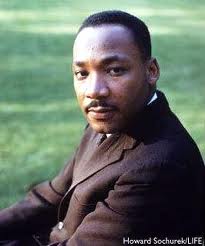
“I cannot forget that the Nobel Prize for Peace was also a commission — a commission to work harder than I had ever worked before for ‘the brotherhood of man.’ This is a calling that takes me beyond national allegiances, but even if it were not present I would yet have to live with the meaning of my commitment to the ministry of Jesus Christ. To me the relationship of this ministry to the making of peace is so obvious that I sometimes marvel at those who ask me why I’m speaking against the war. Could it be that they do not know that the good news was meant for all men — for Communist and capitalist, for their children and ours, for black and for white, for revolutionary and conservative? Have they forgotten that my ministry is in obedience to the One who loved his enemies so fully that he died for them? What then can I say to the Vietcong or to Castro or to Mao as a faithful minister of this One? Can I threaten them with death or must I not share with them my life?”

– “Beyond Vietnam: A Time to Break Silence.” Delivered 4 April 1967, at a meeting of Clergy and Laity Concerned at Riverside Church in New York City